Ketamine Enables Life-Saving C-sections for Women in Developing Regions
“Every minute of every day, a woman dies somewhere as a result of pregnancy or childbirth,” says Thomas Burke, chief of Massachusetts General Hospital’s Division of Global Health and Human Rights.
Ketamine, an inexpensive anesthetic, is a solution to the global crisis of maternal death due to pregnancy, enabling women to undergo C-sections rather than facing death or serious injury.
Each day, 1,400 women die from causes relating to pregnancy. Pregnancy is the second largest killer of women, behind only HIV/AIDS. And for each woman that dies from pregnancy, 50 to 100 are disabled or suffer from disease. Pregnancy related death affects around 15 to 20 million women every year.
A major cause of death and injury during pregnancy is obstructed labor and a lack of availability of a cesarean section. When labor is obstructed and no C-section is available, women frequently die, suffer from postpartum hemorrhage (which can also cause death), or suffer from fistula (where the bladder and rectum walls erode and are permanently connected to the vagina).
Many clinics and hospitals in developing countries lack the ability to perform C-sections because no anesthesia or anesthesiologists are present, which are necessary for this intensive surgery. This lack of anesthesia services presents a global problem, as anesthesia can potentially save countless lives of women.
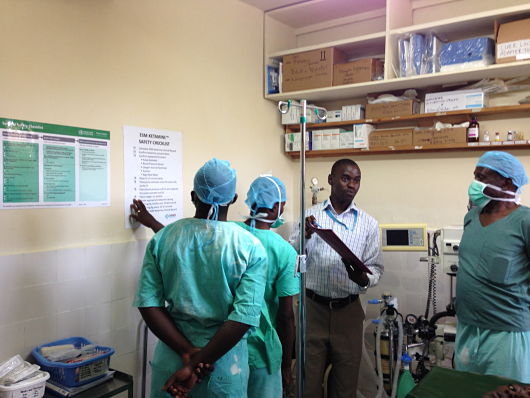
Massachusetts General Hospital is addressing this crisis. They created an innovative way to provide anesthesia services to remote, extremely impoverished regions. Their initiative is called The Every Second Matters for Mothers and Babies—Ketamine for Painful Procedures and Emergency Cesarean Section (ESM-Ketamine). Ketamine is an extremely inexpensive anesthetic; it has been used without any formal procedure around the world for over 40 years, and has a near perfect safety record even with little equipment.
C-sections are the most common worldwide operation. One study of 49 countries estimates that if there was an increase in C-sections (by 2.8 million), 59,100 cases of obstetric fistula and 16,800 maternal deaths would be prevented.
The ESM-Ketamine initiative’s goal is to train clinicians that have no background in anesthesia. The Ketamine initiative offers four days of training for mid-level and above healthcare providers for C-sections and emergency surgeries, using Ketamine as an anesthetic, when no professional anesthetist is available.
Most anesthesia training programs require around four years of training, which is simply not feasible in these developing communities, nor an immediate solution to a crisis that is happening now.
The World Health Organization estimates that 10-15% of births require a C-section. Kenya Demographic Health Survey recently reported that C-section rates in many parts of Kenya are lower than one percent of births. A 2011 Kenya Ministry of Health study also found that only 18 anesthetists exist in the Nyanza region, which has a population of 5.8 million.
Since May 29, 2015, ESM-Ketamine initiative has trained healthcare providers in various hospitals across Kenya, resulting in 231 safe, life-improving surgeries. The program’s initial success demonstrates the powerful potential that Ketamine has for making previously impossible surgeries accessible to women in developing nations, women that provide deeply-rooted social and economic stability to their communities.
When a mother dies or is disabled, her entire community is impacted, and quality of life diminishe—child death rate increases, child education decreases, and both families and communities become more economically unstable.
The maternal mortality rate (MMR), or the ratio of the number of women that die per 10,000 births, was 11.7 in the United States in 2005. In 2014, there are still places on earth where one in six women die from pregnancy related causes; in South Sudan, Afghanistan, and Sierra Leone, the MMR is as high as 2,054.8.
The ESM-Ketamine program provides an inexpensive solution that allows women to undergo cesarean sections, rather than dying or becoming seriously disabled. Healthy women enable a healthy, stable community.
– Margaret Anderson
Sources: Massachusetts General Hospital, World Journal of Surgery, Harvard H Policy Review
Photo: Massachusetts General Hospital
