How Gandhi Utilized Advocacy
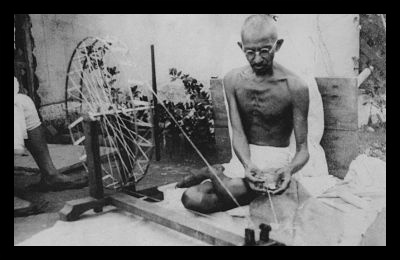
Martin Luther King Jr. once referred to Gandhi’s philosophy as “the only morally and practically sound method open to oppressed people in their struggle for freedom.” Mahatma, or “Great Soul,” Gandhi was an advocate for human rights and is largely known for initiating the idea of nonviolent resistance.
Gandhi’s journey as an advocate began in South Africa. As a young legal adviser, he saw firsthand the damage caused by race-oriented laws and class-based oppression.
This is when Gandhi began to teach his philosophy of passive resistance. Gandhi’s organization of the Indian community in South Africa began widespread social change.
When Gandhi returned to India in 1915, he began working as an advocate for various local struggles concerning working conditions. Four years after his arrival home, British authorities passed the Rowlatt Acts, which allowed imprisonment without trial of any Indian accused of sedition.
Gandhi advocated through a national day of fasting and a refusal to work. He termed this as an act of Satyagraha, or love-force.
Gandhi eventually transformed the Indian National Congress into a large movement committed to nonviolent resistance in support of India’s independence, otherwise known as the non-cooperation movement.
As a consequence of his activism, he was arrested in March of 1922 and served two years for sedition.
Eight years later, in 1930, Gandhi organized 80 volunteers for a 200-mile march to the sea where the volunteers made salt out of seawater in protest of British Salt Laws. The movement eventually grew to 60,000 Indians who were all arrested and imprisoned for their defiance until Gandhi negotiated a truce with representative Lord Irwin.
After Irwin left office and his successor continued the oppressive measures taken against Indians, Gandhi began his movement once again and was immediately imprisoned. In prison, Gandhi began fasting in protest of a new Indian constitution, which was to include different representatives for the “untouchables” or members of India’s lowest level on the caste system.
His fasting gained international attention and was the precursor to the 1947 resolution, which made the discriminatory practice illegal. Britain left India that same year. Gandhi had won his country’s independence back, without the use of violence.
Gandhi’s approach to advocacy inspired many leaders, from Nelson Mandela to Martin Luther King Jr. The Dalai Lama, a follower of Gandhi, expressed, “As Mahatma Gandhi showed by his own example, nonviolence can be implemented not only in politics but also in day-to-day life. That was his great achievement. He showed that nonviolence should be active in helping others.”
– Christopher Kolezynski
Sources: Stanford University, New York Times, MSN News, The Borgen Project
Photo: Wikiphotos
