10 Facts About Africa’s Education Crisis
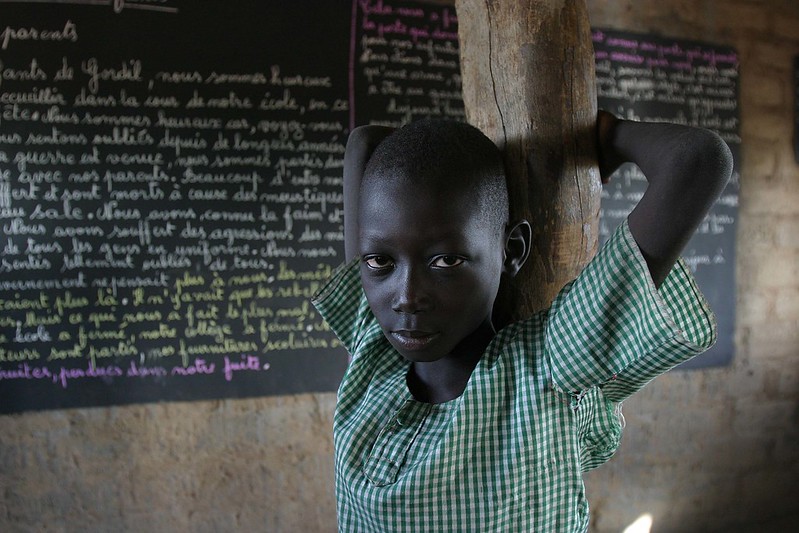
The right to primary education frames many international statements on human rights and education. While South Africa did achieve the Millennium Development Goal (MDG) of universal primary education ahead of the 2015 target year, it is unfathomable to think that 17 million of its school-aged children will never attend school. Africa’s struggling educational sector can be outlined in these 10 facts about Africa’s education crisis.
10 Facts About Africa’s Education Crisis
- There are 12 countries in Africa–namely Malawi, Zambia, Ivory Coast, Ghana, Benin, Nigeria, Chad, Ethiopia, Congo, South Africa, Namibia and Comoros–in which 30 percent or more of children do not meet a minimum standard of learning by grades four or five.
- In countries such as Ethiopia, Nigeria and Zambia, over half of in-school students are not learning basic skills by the end of primary school.
- A global competitiveness report released by World Economic Forum ranks South Africa last out of 140 countries in regards to the quality of education offered. This perception will severely impact the willingness of employers to create more jobs and invest in the country, thus plunging the South African economy further down.
- The fact that only 53 percent of year 12 students who sat for math exams in 2014 achieved above 30 percent, and only 35 percent achieved above 40 percent, shows the extent of the education crisis. One of the more disturbing statistics among these 10 facts about Africa’s education crisis is that 25 percent of South African schools do not even offer mathematics in grades 10 to 12.
- Despite being a middle-income country and having six percent of its GDP spent on education, South Africa’s performance in standardized tests is far below the average for African countries.
- Another major concern is the relation between the language of instruction and student performance. South Africa’s population speaks 11 languages, and students writing the examination in a language other than their mother tongue continue to experience great difficulty in interpreting questions and phrasing their responses.
- Teachers’ knowledge of English is poor, and, unless emphasis is laid on training and preparing teachers, the state of education will not improve. According to the World Bank, teacher absenteeism, neglect and lack of a working knowledge of the language may be blamed for poor student performance.
- In many countries within sub-Saharan Africa, educational disparities exist with respect to wealth, gender and social divisions. The degree of extreme educational poverty, which is defined by less than two years spent in school, is much higher among the poor. For instance, in Ethiopia, a staggering 68.3 percent of the poorest quintile of its population lives in educational poverty.
- According to Action Aid, the economic crisis has meant that around £2.9 billion is expected to be lost to education budgets for the sub-Saharan regions. It is not an overstatement to say that most rich countries have failed to keep their promises to help poor countries out of educational poverty. This is also attributed to the fact that both the International Monetary Fund and the World Bank have severely restricted funding to poor countries, thus reducing their chances of investing in education.
- Despite all these reasons, both internal and international politics play a major role to play in Africa’s educational crisis.
Education is probably the single most influential tool to ensure that poor countries have the resources to pull themselves out of poverty. While many historic, social, economic, political and international issues play an important role in Africa’s existing educational situation, one can only hope that these 10 facts about Africa’s education crisis will shed some light on the existing roadblocks that the continent faces in fighting its education poverty.
– Jagriti Misra
Photo: Flickr
