Women’s Cooperatives in Guatemala
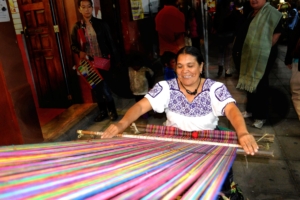 In the highlands of Guatemala, women’s cooperatives are writing a tale of defiance against poverty. Historically marginalized groups of women have united through cooperatives to become the lifeblood of their local economies. The benefits are cascading in metamorphic ripples, transforming entire communities in their wake.
Economic Independence
The most immediate impact is a dramatic rise in household income. Cooperatives like the Cojolya Association guarantee members more than twice the local market rate, shattering legacies of exploitation and establishing women as primary economic actors. This empowerment was a product of necessity, born from the ravages of a civil war that left countless women widowed.
Survivors, now solely responsible for the welfare of their families and the rehabilitation of their communities, founded cooperatives like Trama Textiles, which has grown into a network of more than 400 weavers. Cooperatives like Ixoq Ajkeem demonstrate the power of a collectivist approach with their strategy of pooling resources, leveraging bulk orders and constructing common storefronts. In this way, women’s cooperatives in Guatemala integrate vulnerable and disparate artisans.
They unite them under a single, resilient organizational model. This structure protects families from economic volatility. It also shields individual producers from the unpredictability of the market.
Investing in Health and Nutrition
This economic power creates a direct second ripple: improved family health and nutrition. As primary earners, women consistently reinvest in their families’ well-being, marking a critical shift in a country where a severe poverty crisis drives chronic malnutrition. Through cooperatives, this care becomes institutionalized.
UPAVIM, for instance, has channeled its collective resources into a medical and dental clinic while also initiating targeted campaigns, like a soymilk program, to combat child malnutrition. The women of rural Guatemala continue to teach a lesson in ingenuity by using the cooperative model to transform earnings directly into community health care, ensuring the windfalls of their work are felt throughout their entire locality.
Keeping Children in School
The third ripple and perhaps the most foundationally transformative, manifests in education. Protection from poverty enables children to return to the classroom instead of toiling away in the workforce of manual labor. This commitment is structurally embedded in cooperatives like UPAVIM, which operates its own school.
It also provides members’ children with scholarships for school supplies and meals. These efforts significantly reduce costs and make education accessible to many more families. The result is both tangible and visible. Children in school uniforms are now a common sight.
This change reflects their mothers’ success in securing a right to education denied to earlier generations by poverty. It also signals systemic transformations capable of breaking long-standing cycles of deprivation.
Building Skills and Confidence
The impact of women’s cooperatives in Guatemala transcends material gain, mounting to a fourth ripple of personal empowerment. Beyond the loom, women receive vital training in financial literacy, business management and leadership, highlighting cooperatives as institutions for holistic human development and collective self-sufficiency. This newfound expertise fuels a powerful shift in communal identity. As one weaver from the Aj To’ooneel cooperative asserted, “Women today are entrepreneurs.”
This transformed identity is reproduced at home, reshaping the perceptions of forthcoming generations. “The children of the artisans are seeing that women also have an important role or they occupy the same position as men in the family,” observed Lidia Garcia of Mercado Global. This cycle of empowerment, once begun, becomes self-perpetuating.
Strengthening the Entire Community
These individual ripples converge into a fifth: community fortification, transforming cooperatives into vital civic institutions. Aside from its school, UPAVIM established a health clinic and bakery, establishing a grassroots community support system. This role as a community pillar becomes most evident and most critical during crises.
Throughout the COVID-19 pandemic, cooperatives like Multicolores, Kakaw Designs and Mercado Global leveraged their networks to facilitate emergency food baskets, hygiene supplies and public health information when state aid was insufficient. Ultimately, these women’s textile cooperatives in Guatemala amount to something far greater than the sum of their parts; they weave a stronger, more resilient social fabric for the future.
Final Remarks
The story of Guatemala’s cooperatives is a testament to how women’s empowerment creates a cascade of change. From individual economic independence to healthier families, educated children and resilient communities, the ripple effect is lifting rural communities in Guatemala out of poverty. These cooperatives demonstrate that the most sustainable path to development is not through top-down aid alone, but by empowering those at the heart of communities to become the architects of their own futures.
– Georgio Moussa
Georgio is based in London, UK and focuses on Good News for The Borgen Project.
Photo: Wikimedia Commons
