Poverty Reduction in Sri Lanka
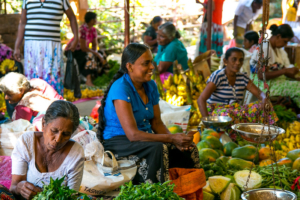 Sri Lanka, formerly known as Ceylon, has a rich history of traditions and cultural development, which has put the nation on the international map. The nation ranks 89th on the Human Development Index worldwide. Sri Lanka has faced an ongoing insurgency between the Tamil minority and the Sinhalese majority. Despite this conflict, the nation has made notable progress. Health care and poverty reduction programs in Sri Lanka, in particular, have improved significantly.
Praja Shakthi
Under the leadership of President Anura Kumara Dissanayake, the “Praja Shakthi” initiative was approved by the Cabinet and launched in July 2025. The program was introduced as part of a broader push to streamline and strengthen poverty reduction programs in Sri Lanka. It focuses on empowering communities through a bottom-up, people-centred approach.
Reports suggest that over the last few decades, the number of poverty reduction programs in Sri Lanka and their beneficiaries has skyrocketed, increasing from 1.10 million in 2010 to 1.79 million people in 2024. The aim was to have a “social security program” that vulnerable populations could access easily. Therefore, the government approved the program with the vision of achieving “Pohosath Ratak – Surakshitha Jeewithayak” (A wealthy country with a secure life).
Accordingly, the program is focused on “empowering communities to drive their own development.” This outlook has emphasized the importance of involving the community in identifying and bringing issues that affect them on an individual level to the forefront, rather than having others who don’t have first-hand experience of poverty speak on their behalf. To cement this approach, the Sri Lankan government has set up Community Development Councils that approve the proposals and help implement them.
Health and Education
It has been reported in The Morning report that the program has aimed to go beyond the poverty reduction mandates of the International Monetary Fund (IMF) and lift people out of poverty at both the regional and village levels. Reports indicate that a critical component of the program is the formal inclusion of health and education. Contrary to previous poverty reduction initiatives, Praja Shakthi has identified and recognized the role of education, giving it similar priority to its health, food security, transportation and marketing principles.
In terms of implementation, the strategy is to work through 14,008 grama niladhari offices across Sri Lanka. The program aims to raise the most impoverished families by assessing their educational, vocational and financial challenges, including their inability to save. Around 50 families per Grama Niladhari Division (GND) will be selected initially to receive personalized development plans focused on employability and entrepreneurship, with support from Samurdhi and Economic Development Officers.
While official selection criteria have yet to be fully disclosed, the government has stated its focus on targeting the most vulnerable households. With ambitious projections on the project’s outcomes and the promise of keeping a close eye on the program’s commitments, things appear to be moving in the right direction. However, the full impact will only become clear over time.
The Aswesuma Program
Another program that has recently gained traction in the media is the Aswesuma initiative. In its initial phase, the program was implemented to create a “poverty-free” Sri Lanka by 2048, focusing on transitioning from a welfare state to an entrepreneurial state. However, due to a lack of proper implementation and consideration for the beneficiaries, the policy received much backlash, lauded as overly politicized and inconsiderate.
However, under the recently revised provisions, Dissanayake announced a revised monthly allowance amount for beneficiaries qualifying under the scheme, which was set to kickstart in January 2025. Under the new structure, recipients were divided into four groups, each receiving a welfare amount proportional to their needs. The four categories include the extremely poor, poor, vulnerable and transitional groups receiving funds ranging from $197 to $56 through 2025. Twenty-two indicators have been identified to determine the selection criteria for prospective beneficiaries.
LIRNEasia’s 2023 national survey found that indicators such as electricity consumption, vehicle ownership and land ownership help identify the most vulnerable populations under the Aswesuma program. These measures allow poverty reduction efforts to be implemented more effectively across the state. As an added measure, the government has introduced a new digital platform to identify potential beneficiaries. The system stores data from four schemes under the Welfare Benefits Information System (WBIS), improving data access efficiency and reliability.
Conclusion
While it’s too early to measure the outcomes of these poverty reduction programs in Sri Lanka, the government’s renewed commitment and structural changes point to a promising shift in a people-centric, data-driven and inclusive perspective. Though the road ahead remains long and the full effect of these programs is yet to be seen, the nation’s fight against poverty has seen a remarkable shift, one where policy is streamlined to its people’s needs. With continued effort, implementation and accountability, Sri Lanka may be on a path to more long-lasting, equitable change.
– Vasudhaa Shakdher
Vasudhaa is based in Vancouver, British Columbia, Canada and focuses on Good News and Politics for The Borgen Project.
Photo: Flickr
