Five Ways Transportation Impacts Global Poverty
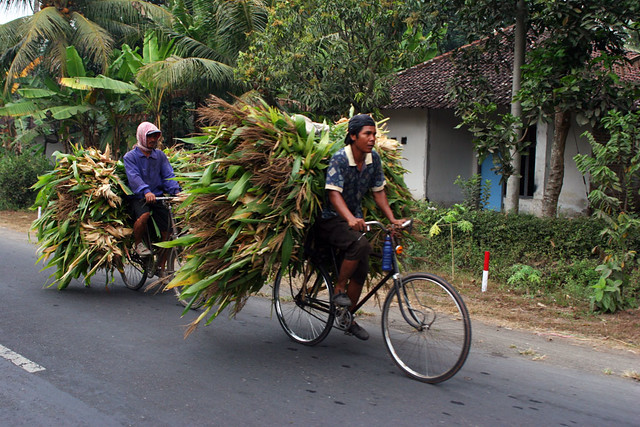
Transportation impacts global poverty in ways that are both obvious and subtle. If the job market is centered in an urban area and potential workers live in a distant, rural area, their immediate survival depends on access to transportation. On a larger scale, the ability for a developing country to transcend poverty and become productive and prosperous depends a great deal on the transportation systems that are implemented with the help of foreign aid. This article analyzes five ways transportation impacts global poverty.
Five Ways Transportation Impacts Global Poverty
- Rural isolation arguably deserves its own list of ways transportation impacts global poverty because it has so many consequences that perpetuate continued destitution. For example, farmers in isolated rural environments often fail to reach their economic potential because they cannot easily access marketplaces that offer seeds, fertilizers and other tools for agricultural success.
- Other casualties of rural isolation are the elderly or otherwise infirm. Healthcare services are usually in centralized urban locations. Even if the poor and sick or even the old, pregnant or injured can afford the costs associated with health services, they are often unable to get to where the providers are if they live in rural communities. World Bank has helped to address this in developing regions of India, Georgia and Vietnam by subsidizing travel costs and making health professionals available in more remote areas.
- Investing in basic infrastructure is often one of the most significant ways in which transportation impacts global poverty. The building of roads, trails and bridges creates greater accessibility even for those who can only travel on foot. Jobs are created to facilitate these developments, and there are often new modes of public transportation implemented to make use of newly created roads or railroad tracks. This helps to minimize the travel time between rural and urban regions. Bill Gates asserts that while domestic resources can and should be utilized for infrastructure investment, global aid is a critical component as well. An investment in a developing country ultimately benefits the entire world, including the wealthiest nations.
- It stands to reason that the more easily a population can access educational facilities, the more educated that population is likely to be. People living more than an hour’s walk from the main road in Papua New Guinea were shown to be experiencing twice as much poverty as those living closer to the road. Building new roads and providing greater access to transportation resulted in an increase in education enrollment and literacy as well as an overall decrease in poverty.
- A theory known as “spatial mismatch” describes a phenomenon in which those who can easily pay for transportation, whether by automobile or public means, move away from congested urban regions. This creates a problem for the poor because the market often follows the wealthy as do the jobs. In developing countries, this is especially problematic since it feeds a cycle of poverty in which cheap housing options are only available in areas where there are few amenities, poor transportation options and limited jobs.
Writer Wilfred Owen asserts, “Continuing global prosperity is contingent on the very large volume of trade with developing countries and on the foreign investment opportunities they provide.” This will not be feasible without a short-term investment in the infrastructure and transportation systems of those developing countries. While the governments of the developing nations play a vital role in upgrading transportation options in their countries, foreign aid must also play a part. As this article shows, transportation impacts global poverty; therefore, it is not a simple matter of charity but rather a wise investment in our global future.
