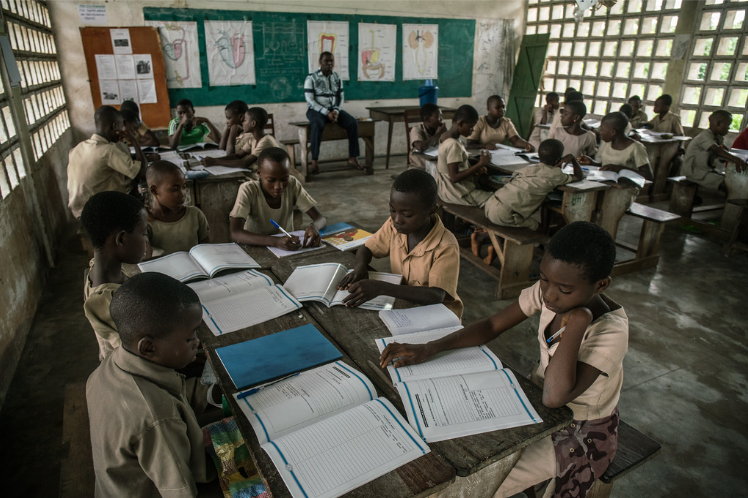
Togo, a small West African nation of around 8 million people, faces serious economic challenges, notably a GNI per capita around $1,010 – one of the lowest in the world. Despite these obstacles, the country has made meaningful educational progress, especially at the primary level, supported by longstanding government reform and international partnerships.
System Structure, Enrollment, and Access
Togo’s education system fits the 6‑4‑3 model: six years of compulsory primary education starting at age 6, followed by four years of lower secondary and three years of upper secondary. Since primary school fees were eliminated in 2008 (thanks to government action in partnership with UNICEF), primary completion has gradually improved. As of 2022, net primary completion was approximately 91% for boys and 87% for girls. However, secondary completion lags behind: lower secondary completion stands at 67% for boys and 60% for girls. The numbers for tertiary enrollment are even worse – 19% for men and just 11% for women. Additionally, adult literacy remains low, about 67% as of 2019. Fortunately, youth literacy (ages 15–24) is trending higher at almost 85%.
Education quality continues to suffer due to overcrowded classrooms, poor teacher training, and shoddy infrastructure, especially in rural areas. Dropout and repetition rates remain high at secondary levels, with extreme gender and geographical disparities: female enrollment and literacy consistently trail male counterparts, while rural students lack access to secondary schooling. To make matters worse, only about 3% of adults participate in education or training programs.
Reform Efforts and the Road Ahead
Togo’s Education Sector Plan (2014–2025) describes reforms aimed at achieving universal primary quality education, expanding pre-primary access, improving secondary and vocational education, and reducing illiteracy. Teacher policy reforms under this framework prioritize a holistic, lifelong approach to teacher motivation, training and professionalism
International support plays a crucial role in these reforms. The Global Partnership for Education (GPE) finances initiatives like civil society strengthening through its Education Out Loud fund, assisting Togolese groups, including the Coalition Nationale Togolaise pour l’Éducation Pour Tous (CNT/EPT) for 2024–2026. Togo also participates in regional KIX Africa projects, focusing on establishing digital education management systems, promoting learning equity, and using data to shape education policy.
Regarding GPE, Togo has received approximately $27.8 million in funding through its Improving Quality and Equity of Basic Education Project. This initiative drastically boosted textbook availability, ensuring that nearly every student received their own copy by 2018, and supported the construction of classrooms. As one teacher in a renovated rural school shared: “For the first time, we have enough books and clean, safe classrooms – my students are more attentive and eager to learn.” This impressive transformation shows the effectiveness of targeted GPE investments.
Togo has made significant progress in expanding access to primary schooling and improving youth literacy, but major gaps persist – particularly in quality and gender equity. Reform momentum, reinforced by plans like the 2014–25 Sector Plan and backed by international partnerships, now needs to translate into measurable learning gains. This would lead to stronger teacher capacity and more inclusive systems for all learners. As Togo continues to bolster its data systems and invest in early and secondary-level education, it’s well-positioned to create a more equitable and hopeful future for its youth.
– Jeff Zhou
Photo: Flickr
