How AI Is Improving Education Systems in the DRC
 The Democratic Republic of Congo (DRC) is enduring one of the most complex humanitarian disasters of modern times. Amid a brutal conflict, political corruption and the pursuit of natural resources, the children of the DRC currently face a raft of life-threatening challenges.
A Nation of Paradox
Despite the DRC being the world’s largest cobalt producer and rich in many natural resources, 28 million Congolese civilians are experiencing acute food insecurity. At a time of great struggle, the people of the DRC suffer at the hands of one of the most persistent and far-reaching conflicts in Africa. An estimated 7.8 million civilians have been internally displaced. At the same time, schools, homes and public infrastructure are destroyed in pursuit of land and resources.
Following years of colonial rule, President Félix Antoine Tshisekedi Tshilombo is accused of contributing to a status quo that perpetrates human rights violations against his people. Hence, DRC ranks among the highest globally in corruption, where wealth fuels conflict and extraction rather than public and economic development. Not only have these issues created an ongoing humanitarian crisis, but they also contribute to unemployment and poverty. More than 70% of the Congolese population lives on less than $2.15 per day.
Education Systems in the DRC
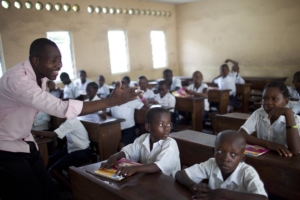
These immense challenges have shattered the education system in the DRC. Around 7.6 million children and half of all girls between the ages of 5 and 17 no longer attend school. Many struggle to complete their studies due to barriers like resource shortages, long distances or economic challenges.
With many schools and education systems destroyed, those operating in the DRC often struggle with overcrowding and underfunding, severely limiting education quality amid ongoing economic and social instability. These compounded challenges lead to low enrollment rates and expose children to serious risks. These include forced recruitment, child labor, violence and deepening poverty, harsh realities in a country where daily survival is already a struggle.
The AI Revolution in Africa
In a changing Africa, AI is set to play a significant role in addressing the challenges faced within public education. By bridging the digital divide and increasing access to quality schooling, AI platforms could prepare students more fully for the demands of a fairer workforce. African EdTech startups have grown rapidly in recent years, offering content that supports learning and teaching in diverse settings. Many now provide materials in African languages and dialects, helping re-empower local communities during uncertain times.
Yet, regardless of AI’s undeniable potential, the DRC ranked 181st globally on the AI Government Readiness Index between 2023 and 2024. This low ranking reflects widespread concerns about government effectiveness and the scalability of AI in underserved rural areas. Despite these hurdles, AI-powered tools now facilitate opportunities for basic educational tools tailored with digital platforms such as Schoolap. These platforms show promise at a time when the DRC’s education system is facing existential threats.
Schoolap
Since its founding in 2017, Schoolap has expanded rapidly, especially after the COVID-19 pandemic accelerated digital learning. The platform now features more than 20,300 educational resources, 6,000 partner schools, 1.9 million registered students and around 105,000 participating teachers across six provinces.
In the face of these many great challenges, by engaging students with innovative adaptive learning platforms, AI is providing children with new and efficient means of education. These means are easier to access and less dependent on their location or socioeconomic status. The app requires users to complete an account form to access its content. This form identifies the learner’s level of study, after which they can access online courses in multiple formats, designed for both primary and secondary students and educators.
Conclusion
The Schoolap platform offers a simple solution as Congolese schools continue to close. It combines digital curriculum management with interactive tools that can address the growing needs of the faltering education systems in the DRC. While the road to long-term safety and security is dangerous, platforms such as Schoolap reveal promising new pathways. They offer more accessible education for the children of a nation deeply affected by war, corruption and the mismanagement of public resources.
– Gabriel John Gunn
Gabriel is based in Paisley, Scotland and focuses on Technology and Global Health for The Borgen Project.
Photo: Flickr
