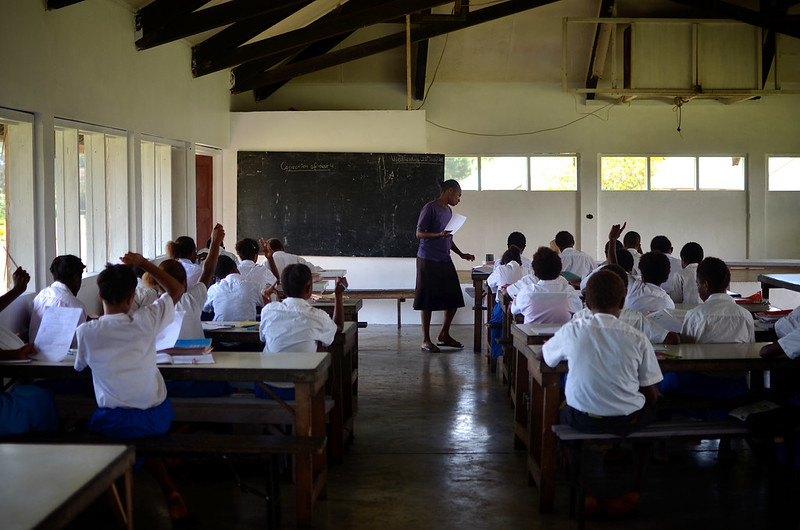
Vanuatu is a South Pacific island nation of 83 islands across six provinces, where distance and transport costs shape whether children can consistently attend school. Its colonial history also formed a multilingual environment (Bislama, English and French) which influences instruction and early literacy, especially when the language spoken at home differs from the language used in classrooms. Vanuatu’s key education challenge today is less about whether children start school and more about whether they finish secondary education and achieve robust learning outcomes, particularly outside Port Vila and Luganville.
Access and Policy Direction
Recent UNESCO SDG 4 monitoring reveals a steep drop-off across education levels. In 2023, Vanuatu’s primary completion rate was estimated at around 81.5% (administrative data), while lower secondary completion was approximately 49.5%, and upper secondary completion just 23.1%. Additionally, modeled trends show upper secondary completion flatlining in the low double-digits over the past decade. These numbers help explain why many families view secondary school as inaccessible, especially when students must board away from home or travel long distances.
Public spending has fluctuated, but recent reporting suggests the government has, at times, allocated a significant share of spending to education. UNESCO’s SDG 4 profile lists education’s share of total government expenditure as about 20.9% (2022-2023) and government expenditure on education as a share of GDP around 10.6%-10.7% (2022-2023), though year-to-year volatility is noteworthy.
There are success stories in Vanuatu’s education system. One of the most notable is the government’s sustained focus on foundational learning, which has helped expand early-grade reading programs. Evaluations of literacy-rich classroom initiatives show better reading fluency, higher attendance, and stronger parental engagement when children are allowed to take books home. A provincial education officer summarized this trend succinctly, “When children start reading confidently in the early years, families see school as valuable – and children stay”.
Programs, Partnerships and Looking Ahead
Vanuatu’s current reform agenda is centered around the Education and Training Sector Strategy/Plan for 2020–2030, which sets an explicit objective to “improve education for all in an efficient and effective way”. The emphasis increasingly includes stronger school leadership and better system monitoring. This ensures that problems, like absenteeism and resource shortages, are identified earlier and addressed more consistently.
International cooperation plays a meaningful role alongside government leadership. The Global Partnership for Education (GPE) has supported a program focused on improving quality in early childhood and primary education through strengthened teacher education and better teaching and learning materials. Furthermore, UNICEF’s regional work has underscored the practical need to bolster teacher capacity for modern instruction, notably digital competencies; UNICEF’s 2024 regional study on teachers’ digital literacy includes Vanuatu in its Pacific spotlight. While reforms vary by province, the direction is clear: greater teaching support, more inclusive classrooms and learning materials that meet students’ needs in multilingual contexts.
Vanuatu’s education story is increasingly about retention and results. The country has clear national strategy priorities and meaningful development partnerships, but certain issues remain: fewer than half of learners complete lower secondary, and only a small minority complete upper secondary. If Vanuatu can scale teacher development as well as make secondary pathways financially and physically feasible, it can transform strong early access into stronger life outcomes – real opportunity for young people across all islands.
– Jeff Zhou
Photo: Flickr
