Access to Drinking Water in Nepal
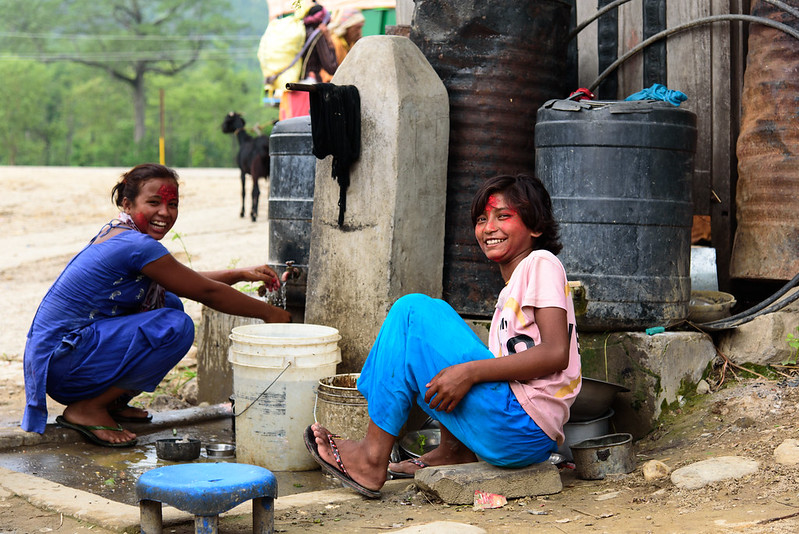 Nepal, officially known as the Federal Democratic Republic of Nepal, is facing challenges with access to clean drinking water. A recent survey found that while 95% of the population has access to basic drinking water, only 16% actively use a “safely managed” drinking water service. In addition, 51% of the population uses a safely managed sanitation service and 64% have a handwashing facility with both soap and water available at home.
Water Quality and Why It Still Affects Nepal
One of the main reasons for the lack of clean drinking water is that Nepal’s supplied water is often polluted. This is primarily caused by both the surface and groundwater deteriorating in the Kathmandu Valley, also known as the Nepal Valley or Nepa Valley. The surface water is polluted by both domestic and industrial waste, along with the discharge of untreated sewage. This is mainly due to the tightly packed residential neighborhoods. The domestic sewage is one of the top contaminants that makes its way into rivers and lakes, the primary sources of Nepal’s drinking water.
The Effects
Nepal’s capital city of Kathmandu produces about 150 tons of waste daily and nearly half flows into rivers. This is one of the main reasons that many Nepalis are not able to obtain clean drinking water from available sources. In some of the more rural regions of Nepal, many communities still rely heavily on tube wells for drinking water. More recently, one of the main concerns in these regions is groundwater contamination from arsenic. The Terai Region contains dense layers of sand and gravel deposits interlocked with flood plains carried by rivers and is very prone to arsenic contamination.
The Nepal Water Initiative
Emphasizing the themes of community engagement, student involvement and interdisciplinarity, the Nepal Water Initiative brings together the distinct perspectives of both marine and conservation science with those of religious studies, economics and anthropology, with the hopes of providing the people of Nepal with safe, accessible drinking water. A fundamental, guiding principle of this project is that it must be Nepali-driven, meaning that all of its work is both developed and implemented with the participation of Nepali stakeholders, community leaders, scholars and policy makers.
Another project, known as the Melamchi Water Supply Project, aims to bring clean water to Nepal, specifically within the Kathmandu Valley region. Furthermore, the Nepali government is currently working on a National Water Supply and Sanitation Act, as well as a Sector Development Plan aimed at guiding development and setting a roadmap for the near future.
Looking Forward
Efforts are underway to address the current water crisis in Nepal, including government initiatives, international aid and community-based projects that focus on water management, infrastructure development and promoting water conservation. These efforts show the desire to bring change, not only by Nepalis but also by countries around the world working together to ensure that Nepal receives the aid and care it needs to become a successful, healthy country.
– Simone Sanchez
Simone is based in Huntington, NY, USA and focuses on Good News and Global Health for The Borgen Project.
Photo: Flickr
