Dairy Farming Innovation in Africa
 In much of Sub-Saharan Africa, poverty remains deeply rooted in rural life. According to recent estimates, the region accounts for a disproportionate share of the world’s poorest populations, with 553 million people living in multidimensional poverty and limited access to basic services.
In an unexpected corner of agricultural science, a new approach is taking shape, one that begins not with infrastructure or aid packages but with cows. Increasingly, dairy farming innovation in Africa is helping reshape what opportunity looks like for rural families.
A Cross-Continental Scientific Partnership
At the heart of this transformation is a collaboration between British scientists and African researchers, working through institutions like Scotland’s Rural College and the International Livestock Research Institute (ILRI). Together, they are rethinking how dairy farming can empower smallholder farmers by breeding cows that are not only more productive but better suited to local environments.
The science began in the U.K. Researchers Raphael Mrode and Mike Coffey focused on a simple question: what if cows could produce more milk while requiring fewer resources? According to a Gates Foundation report, the team studied ways to breed smaller cows that would require less feed and less land to graze on while producing more milk than larger cows. They identified the genetic traits that led to healthier cows with higher milk production.
Even in Scotland, the gains were measurable. Farmer Rory Christie noted that since the project began, his herd has produced about 1,000 liters per cow per year extra. This breakthrough laid the groundwork for dairy farming innovation in Africa, showing how science could directly improve productivity.
From Research to Real-World Impact
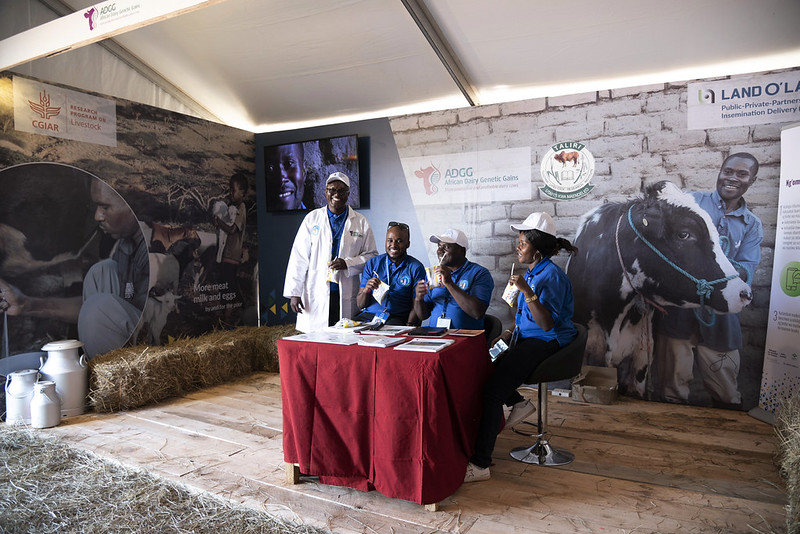
Recognizing this potential, the research expanded beyond Europe. Scientists Okeyo Mwai and Julie Ojango in Nairobi joined forces with Mrode, forming a partnership that would eventually become the African Dairy Genetic Gains (ADGG) program. The goal of ADGG is to provide small-scale dairy producers in Sub-Saharan Africa access to feed-efficient and well-adapted cows to increase their income.
The challenge in countries like Kenya was not a lack of cows but a lack of clarity. Local herds had become what Julie Ojango described as a “fruit salad” of mixed breeds. Years of unstructured crossbreeding and imported genetics meant that farmers often had no reliable way to know which animals would be most productive. Despite continued investment in imported semen, results were inconsistent.
ADGG set out to change that by bringing data into the equation. The program began systematically collecting information on thousands of animals, tracking performance and applying genomic tools to identify the most promising traits. The initiative aimed at developing and testing a genetic gains platform that uses on-farm performance information and basic genomic data to identify and prove superior crossbred bulls for the benefit of smallholder farmers in Africa.
The Power of Hybrid Cows
Researchers discovered that certain hybrid cows outperformed both traditional local breeds and exotic imports. These hybrids were not only more productive but also better adapted to African climates and farming conditions.
Currently, these improved cows are being distributed through community networks and artificial insemination programs. The impact is measurable across Kenya, Tanzania and Ethiopia, where thousands of farmers are seeing higher milk yields, more stable incomes and new opportunities.
Okeyo Mwai, principal scientist at ILRI, said that milk is one of the most nutritious animal-sourced foods, and increasing milk yield expands opportunities for food and national security for both farmers and their neighbors.
From Subsistence to Opportunity
For many families, milk is reshaping futures. One Kenyan farmer, Josephine Kimonyi, said the milk from a single improved cow helped her household pay school fees for her children and brought stability to the family.
Across the region, increased milk production is enabling farmers to move beyond subsistence. With surplus milk to sell, families are becoming small-scale entrepreneurs, investing in education, health care and better living conditions. These accounts highlight how dairy farming innovation in Africa is changing livelihoods at the household level.
Looking Ahead
Governments, scientists, nongovernmental organizations (NGOs) and farmers are collaborating in this effort. ADGG data shows that more than 56,000 farmers and more than 94,000 animals have been registered across Africa, and the program continues to grow. By combining science with local knowledge and focusing on tools farmers can use, this initiative is turning an everyday resource into a pathway out of poverty.
– Lucy Kerr
Lucy is based in Coventry, UK and focuses on Good News, Politics for The Borgen Project.
Photo: Flickr
