Clean Cookstoves in Kenya Save Millions of Lives
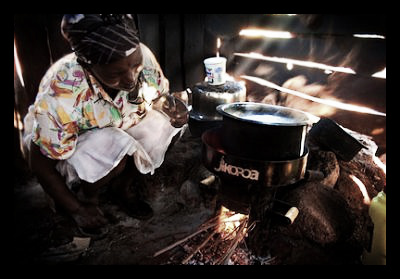
More than seven billion people live in this world. Yet, according to the World Health Organization, more than 3 billion risk experiencing serious respiratory infections and early death simply by cooking food and heating their homes using traditional wood stoves and solid fuels instead of clean biogas cookstoves.
The National Clean Cookstoves and Fuels Conference at Nairobi, Kenya in February was sponsored by the Global Alliance For Clean Cookstoves (GACC). The conference drew attention to a simple fact: “Cooking is essential and should not kill,” noted Radha Muthiah, the executive director of GACC.
In Kenya alone, illnesses linked to cookstove smoke claim 15, 700 lives a year. Yet 84 percent of the country continues to uses solid fuels for cooking.
Naturally, the most affected group are mothers – responsible for the bulk of the cooking – and children. Muthiah shared this tragic figure: 8,300 Kenyan children die annually due to respiratory infections attributed to this indoor air pollution.
The solution, though clear, poses a high cost.
Isaac Kalua, chairperson of the Kenya-based Green Africa Foundation, asserted, “We are losing people because of indoor [air] pollution and we therefore need urgent transition from traditional methods of cooking to modern technologies.” He continued by observing that the “affordability of the new technologies is a main challenge to providing clean fuels for all.” Such technologies include reliable, safe biogas cooking stoves, used in conjunction with biogas digesters.
Despite the cost, a number of donors in place who recognize the needless loss of life and are committed to helping Sub-Saharan Africa address this issue. During the February GACC conference, several organizations pledged their continuing financial support. Benefactors include the UN Foundation, which has invested $3 million this year. GACC aims to provide reliable cookstoves and clean fuels globally.
The U.S. government awarded $1 million to three Kenyan organizations. This recent donation continues a lengthy history of support: since 2010, the US has contributed $125 million to GACC.
Though financial support is critical, outreach to those at risk equally addresses the harms of indoor pollution. These education efforts extend to women, as well as farmers. As the popularity of diary farmer grows in Sub-Saharan Africa, sources for biogas are expanding, According to SciDiv.Net, biogas “is a system that converts organic waste from livestock manure into energy for cooking” and heating. This system burns cleanly, because the biogas fuel does not release toxic emissions.
Consequently, biogas offers the opportunity to circumvent the health risks associated with traditional wood burning stoves.
Tradition, however, is formidable opponent. Mary Njoki, a rural Kenyan mother of five, shared this observation: “Biogas is good because it cooks fast but I still use wood fuel when it is the cold season to warm the house and cook food, since during this period, the heat produced by biogas is not sufficient.” Organizations world wide are committed to changing not only Mary Njoki’s mind – but the habits of millions of families heating their homes and cooking food for their children.
As Radha Muthiah observes, “using clean, efficient, and safe cookstoves” reduces fuel consumption, exposure to toxins and deforestation. And, most importantly, save millions of lives.
– Ellery Spahr
Sources: SciDevNet, Sci Dev Net, Global Alliance for Clean Cookstoves
Photo: Burn Design Lab
