The Abahlali Movement’s Role in Eradicating South African Poverty
Apartheid in South Africa began in 1948 when the National Party was voted into power, favoring the white minority over the black majority. The African National Congress (ANC) then rose up to lead an opposition to apartheid and many ANC leaders, like Nelson Mandela, were imprisoned for years. Eventually the National Party became willing to negotiate a non-violent transition to a majority black rule after numerous protests. Apartheid came to an end after the first multi-racial elections in 1994, bringing the first black president into power: Nelson Mandela. Since then, the ANC has struggled to make the country equal for all races after all of the imbalances the apartheid created with things like healthcare, education and housing.
The Abahlali baseMjondolo Movement (also known as the Shack Dwellers Movement) was created to spread equality and help to fully end the long-lasting effects of apartheid. It started in early 2005 in Durban, South Africa and is still largely located in this port city, but it has become the largest organization of militant poor in South Africa in terms of mobilized peoples. The movement originated with a road blockade near the Kennedy Road settlement that was protesting a local industrialist buying the nearby land that these shack dwellers were promised by the new ANC government in order to create better housing.
This movement has grown rapidly to having over 30 settlements with tens of thousands of shack dwellers supporting them. The movement has suffered over a hundred arrests, ongoing death threats, regular police assault and intimidation from local parties in the last couple years alone. However, it has still been able to progress to the point that it has a persistent voice for inhabitants of informal housing settlements. Against the actions that have thrown thousands of people out to the streets, they have marched on and occupied police stations, offices of local councilors, newspaper offices, municipal offices and the City Hall.
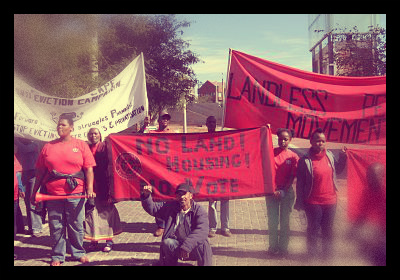
Under the slogan “No Land, No House, No Vote,” the group has organized a very controversial, but extremely effective boycott of the local government elections. The Abahlali baseMjondolo Movement is distinctly against all forms of discrimination, corruption, repression and the concentration of land, wealth and power in any one party’s hands. They stand for a fair distribution of this land, wealth and power and for the right of the city’s inhabitation for every citizen.
Amongst other victories, the Abahlali baseMjondolo Movement has won access to schools, stopped the industrial development of the land promised to the Kennedy Road residents, democratized the governance of multiple other settlements, stopped countless evictions and forced multiple government officials and projects to actually focus on the poor. The movement’s main goal was originally to obtain land and housing in the city, but since it started it has successfully politicized and fought for an end to forced removals and for access to education, water, sanitation, health care and electricity. The movement has even set up gardening projects and sewing collectives for people living with AIDS and for orphans with AIDS.
For more information, address the Abahlali baseMjondolo Movement’s webpage at https://abahlali.org/ or watch the documentary about the movement entitled “Dear Mandela,” with the following webpage: https://www.dearmandela.com/.
– Kenneth W. Kliesner
Sources: Dear Mandela, Abahlali (1), Abahlali (2), CIA World Factbook
Photo: Western Cape
