Education in the Urban Slums of Pakistan
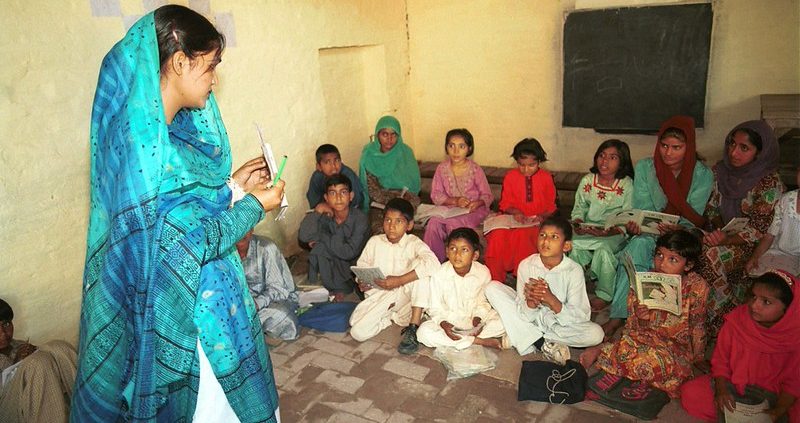 In the extensive informal settlements on the borders of Islamabad, Rawalpindi and Taxila, children wake up not to go to school but to work. They gather recyclable materials such as plastic, glass and metal from waste sites to sell to local recyclers. They sell snacks and flowers on the roadside corner. Some of them beg, and some take care of their siblings while their parents are at work. For these children, education is a privilege rather than a right.
The Borgen Project spoke with Anoosha Malik, a social activist who works with these communities, about the barriers and challenges to education in the urban slums of Pakistan. Malik frequently visits these communities to teach the children and shared deep insights.
A Crisis by the Numbers
Pakistan is ranked second-highest in the number of out-of-school children in the world. Approximately 25.1 million children, ages 5 to 16, are out of school. In 2023, the Pakistan Bureau of Statistics census revealed the figure of 25.37 million. Among these out-of-school children, 53% are girls. Seventy-nine percent of these children never enroll in any educational institution or school.
Mostly, children do not attend school due to poverty. Pakistan’s urban slums, also known as Katchi Abadis, are considered among the poorest communities. In the urban slums of Pakistan, this problem is more concentrated. The Ministry of Human Rights report highlighted that 70% of slum children in Islamabad are out of school, totaling 2,174.
The View from the Ground
Malik, as a social activist who regularly visits the slums of Islamabad, Rawalpindi and Taxila to teach the students, witnesses the human reality behind the data. Families in these Katchi Abadis are caught in a loop; parents who never attended school find it challenging to navigate the enrollment process for their children. Many do not have birth certificates for their kids, which public schools demand at the time of admissions.
Malik said that most households in the Katchi Abadis live in chronic poverty. Families are forced to choose between food and education. The problem is not only poverty. These settlements lack trust in the government and other institutions; they have a rigid mindset that accepts they will never be included in society. Some parents even said that their children will never get a job, even if they learn. However, the consistent efforts of grassroots non-governmental organizations (NGOs) are working to change this picture.
The Citizens Foundation
The Citizens Foundation (TCF) was established in 1995. Its founders identified a lack of education as a cause of poverty. TCF started by establishing five schools in Karachi’s slums. Currently, TCF runs 2,261 school units nationwide, serving 320,000 students.
TCF has a unique faculty model, staffed entirely by women. Some 16,500 female teachers and principals make up TCF’s workforce, and TCF is one of the largest employers of women in Pakistan in this sector. This was an innovative approach and a strategic response to particular cultural barriers.
In the conservative communities of Pakistan, the concept of purdah prevails, which forbids women from associating or interacting with men to whom they are not related. Families often refuse to send their daughters to schools staffed by male teachers. TCF’s all-female faculty eliminates this objection. According to Malik, community members show trust in TCF schools because of the female-only staff.
The results of using these models show success, as TCF maintains around 50% female enrollment (p. 4). In Pakistan, only 60% of students pass the secondary threshold, compared with 96% of TCF students (p. 6). Around 70% of TCF graduates continue on to college studies (p. 6).
TCF charges a $1 fee for primary school and $1.25 for secondary school, and some students receive a fully funded scholarship. It also provides books and school uniforms. TCF students have outperformed peers in several provincial-level assessments and competitions, reflecting a structure built specifically to address the barriers to education in Pakistan’s urban slums.
Pehli Kiran Schools
Pehli Kiran Schools is dedicated to providing quality education to out-of-school children across Pakistan. It was founded in 1995 on a very small scale, with one teacher and 10 students. Development professional Sabira Qureshi started the initiative by teaching young snack sellers in the slums of Islamabad. The name of the organization, which means “the first ray of light,” reflects its aim and vision.
Pehli Kiran Schools are not conventional schools. They can move along with the residents of the slums they serve. Most Pehli Kiran Schools use mobile infrastructure that can be easily disassembled, transported and reassembled at a new site. As the organization puts it, “if children cannot come to school, the school must go to them.”
The academic model is also flexible, using a Montessori-based approach, since many of the children have never attended school before. For children who are far behind grade level, accelerated learning programs bring students to a grade 5 level within 24 months. Evening and morning shifts are both available to accommodate more children.
Currently, the organization serves roughly 3,000 students and operates eight schools. Fees range from $1 to $1.75 per month, with waivers provided to families who cannot afford them. Pehli Kiran Schools are yielding results by helping overcome barriers to education in Pakistan’s urban slums.
Looking Ahead
TCF and Pehli Kiran are effective in overcoming the challenges to education in the urban slums of Pakistan. Both organizations are innovative and address distinct dimensions of the same crisis. TCF, with its all-female teaching faculty, addresses the cultural and social barriers that prevent girls from accessing education. Its fee structure is also designed to encourage marginalized communities living in the slums to send their children to school.
Pehli Kiran Schools serve communities that are unreachable through permanent institutions. Its mobile infrastructure ensures that a child’s education continues even if the community moves. Its Montessori-based syllabus and accelerated learning programs make it more effective.
Both organizations work at different scales but share the same commitment. As Malik highlighted, grassroots NGOs treat these communities as potential partners, while other institutions treat them as problem zones. Local NGOs are successfully combating challenges to education in the urban slums of Pakistan.
– Noor Ul Ain Ameer
Noor is based in Islamabad, Pakistan and focuses on Good News and Technology for The Borgen Project.
Photo: Flickr
