Remembering Refugees in Lebanon
While the Syrian civil war and other conflicts in the Middle East continue to make international headlines, the refugee crisis caused by these conflicts has slowly faded from the public eye. Many countries around the world are now focused on more immediate internal problems. For Syria’s neighboring countries, though, the refugee crisis continues to be an impactful part of their society.
Lebanon is one of these countries. This country shares most of its land border with Syria, and this made it an obvious place for war refugees to flee. The government has allowed many to remain in the country. Estimates say that there are still more than 1.5 million Syrian refugees in Lebanon, and this is only part of the country’s refugee population.
Syrian Refugees in Lebanon
Life for Syrian refugees in Lebanon today is complicated, to say at least. While they are allowed to stay within the country, a combination of unfriendly government policies and heavily-strained infrastructure mean that few can maintain a high quality of life. Residency laws are difficult to navigate, leaving many fearful of arrest and open to exploitation.
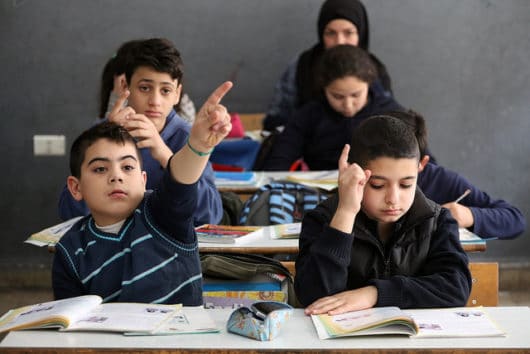
Good work is hard to find, and 71 percent of Syrian refugees live below the country’s poverty line. This lack of financial resources helps explain why more than 200,000 refugee children were kept out of school in 2016. This education gap will only lead to more economic vulnerability in the long term.
Compounding these difficulties is the legitimate strain that 1.5 million refugees put on a Lebanese population that totals only six million. The Lebanese residents of some host communities are outnumbered by refugees. Since the start of the crisis, government spending and debt have risen while GDP has dropped and expenses have mounted. The economic troubles have heightened perception of refugees as a drain on Lebanese society and many want them to return to Syria. Of course, many Syrians would like to return home as well, especially given the conditions in Lebanon.
With the war continuing to progress, though, the United Nations does not recommend that refugees return. President of Syria, Bashar al-Assad, and his government continue to make returning difficult even for those that would like to take the chance. Beyond the obvious physical danger of the ongoing conflict, a strict military draft and the threat of property seizure for the many refugees who are left without formal documentation for their homes are harsh deterrents for many people.
Palestinian Refugees in Lebanon
It’s important to note that Syrians are not the only refugees in Lebanon. A population of around 270,000 Palestinians has settled in a few dozen U.N. camps around the country. Many of these people (or even parents of these people) have been in Lebanon since the Palestinian war in 1948. Today, these camps are essentially considered permanent settlements, and their longevity is part of what has inspired a more aggressive governmental push to ensure that Syrian refugees are only settled temporarily.
Palestinians in Lebanon have always been considered a separate legal class, with restricted access to certain public facilities, educational paths, careers and job opportunities. Many are forced to take low-paying, informal jobs.
The Syrian crisis has made life even more difficult for them, as both refugee groups must now compete for the same undesirable jobs. In 2015, 23 percent of the Palestinian population in Lebanon was unemployed. That number was only 8 percent before the crisis. Conditions are even worse for the 33,000 Palestinians who were living in Syria and have since become refugees in Lebanon as 93 percent of these people are reliant on U.N. aid as their primary source of livelihood.
International Aid for Refugees
While international news has largely moved on from the crisis, international aid continues to be involved in Lebanon and other similarly-strained countries. Thousands of families receive aid from U.N. groups, nonprofit organizations and other groups like the World Bank, to supplement governmental support and their own limited personal resources.
These sources of aid can be effective at reducing poverty, but many have been geared at short term solutions so far. As budgets and international aid dry up, support for the refugees in Lebanon will likely be most effective if it focuses on the long term effects. Groups like Habitat for Humanity are hoping to improve living conditions by building new homes and renovating old buildings as well as water and sanitation facilities. The UNHCR also has plans to shore up Lebanese infrastructure as part of the international effort.
However, with the instability in the region and the ongoing pressure to return to Syria and Palestine mounting, permanent solutions may not be a winning political idea in Lebanon. Time will tell, but in the meantime, it is vitally important not to forget the millions of people- Syrians, Palestinians, Lebanese and others- who are still impacted by the Syrian refugee crisis.
– Josh Henreckson
Photo: Flickr
