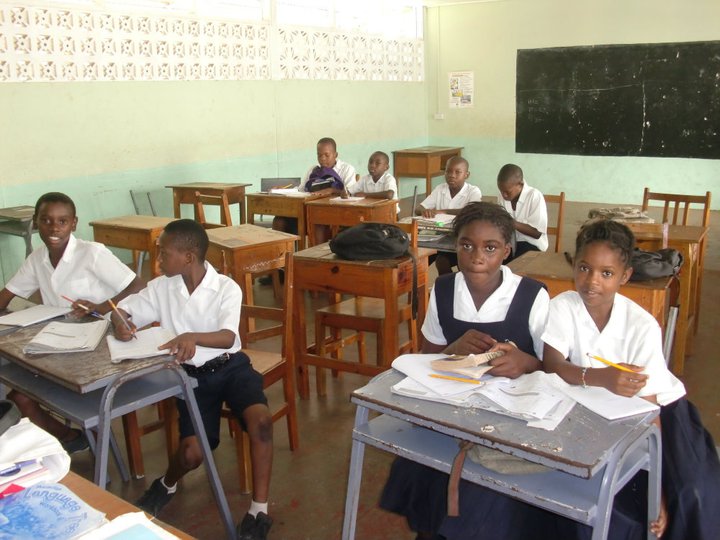
Since gaining independence from the United Kingdom in 1979, St. Vincent and the Grenadines (SVG), a Caribbean island state with a population of just over 110,000 people, has made significant progress in expanding access to education. Today, education policy in the country focuses not only on enrollment but also on learning outcomes, completion rates and gender equity: areas where the country still faces challenges.
Education System Structure and Key Trends
SVG’s modern education system reflects its British colonial legacy, with schooling divided into primary, secondary and post-secondary levels. Education is free and compulsory for children ages 5 to 16, covering the primary and lower secondary years. Primary education usually lasts six years, after which students take the Caribbean Primary Exit Assessment (CPEA) before entering secondary school.
At the end of secondary school, students typically sit for Caribbean Secondary Education Certificate (CSEC) exams administered by the Caribbean Examinations Council (CXC). Performance on these exams determines eligibility for tertiary institutions such as St. Vincent and the Grenadines Community College (SVGCC). Despite the small size of the country, the education system reaches most children. UNESCO data reveal that primary school enrollment in St. Vincent and the Grenadines exceeds 95%, suggesting near-universal participation at early levels.
Outcomes, Initiatives and Looking Ahead
Unlike many developing countries, gender disparities in SVG increasingly show boys falling behind girls rather than girls lacking access. UNICEF reports that girls generally have higher secondary completion rates and better academic performance in several Caribbean countries, including St. Vincent and the Grenadines. Education officials in the country have acknowledged this shift. According to the Ministry of Education, female students make up a growing share of high-performing candidates in CSEC exams, particularly in language and humanities subjects.
This trend is also visible in tertiary education. Enrollment data from St. Vincent and the Grenadines Community College indicate that women account for the majority of students in many academic programs, especially in teacher training, business, and health sciences.
Although enrollment is high, outcomes depend heavily on exam performance. Across the Caribbean, passing five or more CSEC subjects including English and mathematics is considered the benchmark for strong secondary completion. Regional education reports found that SVG performs around or slightly above the Eastern Caribbean average on this measure; however, results vary by year and subject.
One concern remains the male dropout rates during lower secondary school. Research from Caribbean education studies has discovered that boys are more likely than girls to disengage from school early, often due to informal employment opportunities or behavioral issues in classrooms. This dynamic partially explains why girls tend to outnumber boys in upper secondary classrooms, even though enrollment rates at earlier levels are similar.
Another major priority for SVG policymakers is ramping up technical and vocational education and training (TVET). The government has established vocational pathways that connect education to employment in tourism, construction, agriculture and maritime industries. These programs aim to decrease youth unemployment and provide alternatives for students who may not pursue conventional academic pathways. Additionally, modernizing TVET is seen as critical for small island economies that depend heavily on specialized labor markets.
Overall, St. Vincent and the Grenadines has built a solid foundation for education with high primary enrollment and increasing female academic success. The next barrier lies in improving learning outcomes and bolstering vocational pathways that link schooling to employment opportunities. As Caribbean education leaders often emphasize, the objective is not simply keeping children in school but ensuring they leave with the skills needed to thrive in the future.
– Jeff Zhou
Photo: Flickr
