Fighting Malaria Fights Poverty: Malaria Prevention in Ghana
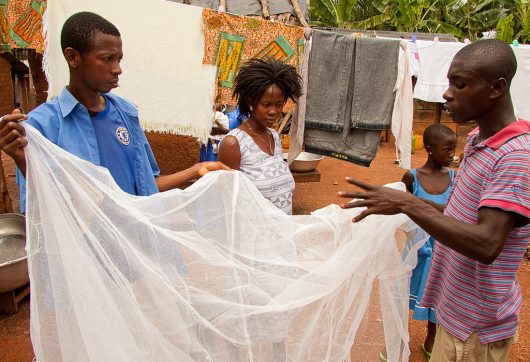
Volunteer Adofo Antwi (right) explains to mother-of-four Ama Konadu in Apenimadi, Bonsaaso Millennium Village, how to hang a bednet. Trained by Millennium Village Project staff, volunteers across the cluster work with communities to hang bednets at all sleeping sites and educate local people about the dangers of malaria. Since 2006, over 30,000 long-lasting insecticide-treated bednets have been distributed, covering all households in the cluster.
Malaria prevention in Ghana is a focus of the nation’s Health Service efforts and is seen as the largest epidemic tormenting the Ghana people. Malaria is a potentially deadly disease caused by a one-celled parasite known as Plasmodium. This parasite is carried and transmitted by the Anopheles mosquito that feeds of humans.
People who become infected with malaria often show flu-like symptoms such as: fever, chills, aches and more. The devastation of this disease on not just the people, but the social and economic structure of Ghana, cannot be understated.
Who is Most Vulnerable to Malaria?
Over three million people contract malaria every year in Ghana which accounts for 44.5 percent of all outpatient attendances. Nearly half of all malaria cases in Ghana are children under the age of five and the disease is responsible for 12 percent of under-five deaths. Of those who die from malaria, 85 percent of them are children.
With such devastating numbers, especially for the nation’s children, it is no wonder malaria prevention in Ghana is the top priority of health officials. Not only are the children of Ghana at a greater risk of contracting malaria, but it also disproportionately affects pregnant women whose immune systems are lowered and more vulnerable during pregnancy.
Pregnant women who contract malaria can see severe adverse health effects such as maternal anemia which leads to: miscarriages, low birth weight, and even maternal mortality.
How does Malaria Affect Ghana?
Malaria prevention in Ghana doesn’t just save the lives of children and their mothers, but it also is necessary for the economic and technological growth of Ghana. Malaria has historically been the number one cause of illness and morbidity in Ghana, but malaria is also a major cause of poverty and poor productivity.
With nearly half of the three million malaria cases every year attributed to children, staying in school falls to the wayside as families focus on the recovery of their children. Being taken out of school, greatly affects one’s future earning capacity for themselves, their family, and their future children.
Obtaining an education is often the biggest tool to improving living conditions of not just the individual and their family, but the community as well.
Not only are children at a risk of death after contracting malaria, but children who survive and fight the disease carry long-term consequences into adulthood such as seizures and brain dysfunction. These conditions can make it difficult once the disease is gone to go back to school and receive an education.
Treating and fighting the malaria endemic costs Ghana a significant amount that causes economic growth to be slowed by 1.3 percent a year in Africa; the annual economic burden of malaria is estimated to be 1-2 percent of the Gross Domestic Product in Ghana.
Roll Back Malaria Initiative: Goals and Successes
In 1999, Ghana signed onto the Roll Back Malaria initiative developing a strategic plan of action for implementation. The goal of malaria prevention in Ghana, as dictated by the initiative, is to reduce malaria specific morbidity and mortality by 50 percent by 2010 and 75 percent by 2015.
While Ghana did not meet those deadlines at the expected times, Ghana continues to strengthen health services to make malaria prevention techniques more available to the people of Ghana. Strategies for malaria prevention in Ghana as seen on Ghana’s Health Services page includes the:
- Promotion of insecticide treated bed nets usage; chemoprophylaxis in pregnancy and environmental management to reduce rate of infection
- Improve malaria case management at all levels (from household to health facility);
- Encourage evidence-based research to come up with effective interventions and
- Improve partnership with all partners at all levels.
The Roll Back Malaria Initiative in Ghana empowers the nation to pursue goals to better equip health facilities with malaria diagnostic tools (microscopes or RDTs) and effective antimalarial drugs. Furthermore, the implementation of indoor residual spraying and the spread of insecticide treated materials such as bug nets, have shown success.
The Need for Scale-Up
Nearly 750,000 lives have been saved across Africa due to the Roll Back Malaria Initiative, but the fight for malaria prevention in Ghana still has a long journey ahead. Ensuring children in rural areas have access to clinics and malaria treatment options can be tricky.
Ghana still calls for a scaling up of this community-based treatment in more secluded districts; in districts where treatment is available, the cost of treatment can be out of reach for many families. The inability to access such resources decreases community engagement in treatment, and demonstrates how great the need in Ghana is for affordable malaria prevention methods.
– Kelilani Johnson
Photo: Flickr
