10 Facts about the Boko Haram Insurgency
 Despite its economic and resource potential, Nigeria, the most populous country in the African region, remains a poor country with a rising poverty rate, now projected at 60.9 percent, according to the National Bureau of Statistics. Besides government planning and expenditure, the activities of the Boko Haram Insurgency remain one of the most significant problems.
The Boko Haram Insurgency, a jihadist rebel group, is internationally recognized and condemned as a terrorist organization. Its ideology stems from the concept of Haram, or a rejection of western education, social and political systems.
Consequently, the following facts encompass some of the most crucial details of the Boko Haram Insurgency.
- The inception of the Boko Haram Insurgency can be traced back to 2002. The group declared a supposed ‘caliphate’ in Nigeria back in 2014. Its activities are closely associated with that of a so-called Islamic State. Owing to the widespread influence of the group, the Nigerian government was forced to declare a state of emergency.
- The group is infamous for its influence and indoctrination of youth and for perversions against the education system in Nigeria, in concentrated areas like Borno, Yobe and Adamawa. The group is known to operate from its stronghold in the town of Borno.
- Over the course of eight years and since the beginning of the group’s activities, over 20,000 people have lost their lives, with many bodies often unaccounted for. Recently, Borno state declared that over 52,311 children have lost their families in the fight against the Boko Haram group.
- In 2014, the group gained ubiquitous condemnation for the kidnapping of over 200 schoolgirls from the town of Chibok. Even though many of them were freed with the help of collaborative discussions between the Nigerian and Swiss governments and the rebels, Amnesty International cites that over 2000 children remain in captivity.
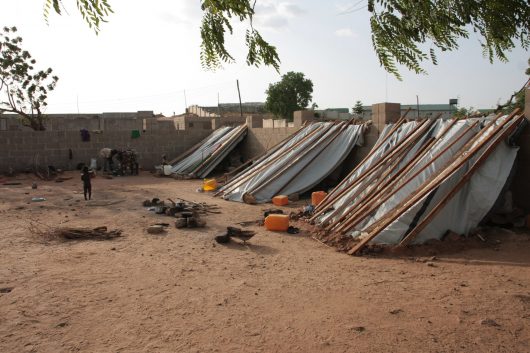
- A majority of the civilians caught in the violent actions of the Boko Haram Insurgency are often housed in ramshackle government refugee camps, where resources and necessities are scarce.
- Since 2009, a lot of the violence has been concentrated in the Lake Chad region. According to the Norwegian Refugee Council (NRC), over 800,000 children under the age of five around the area are deemed ‘severely malnourished’. An estimated $2.2 billion is needed to address the humanitarian emergency. Fortunately, the UNDP and Germany are working collaboratively on an integrated project that could potentially reach over 20 Nigerian communities.
- In recent years, the Nigerian Army has been able to recover a large portion of lost territory and reduce the group’s influence in the country. The Army recently captured a Boko Haram commander and freed around 212 hostages in the process. Moreover, the U.N. has spent a lot of effort on strengthening Sahel security forces in Lake Chad.
- In October 2017, the U.K. government pledged its support to Nigeria in the fight against the Boko Haram Insurgency. Currently, they will help the Nigerian military bolster its capacity by providing effective training. The British Military Advisory and Training Team (BMATT) and the Liaison Support Team (LST) will play a crucial role in further actions in Nigeria.
- According to a recent report by BBC News, the home of the founder of the Boko Haram Insurgency, Mohammed Yusuf, will be converted into a museum. The founder died during a police interrogation in the early stages of the group’s activities in the year 2009.
- According to many Nigerian researchers, a community- based approach toward combatting the problem is recommended.
Overall, the activities of the Boko Haram Insurgency seem to be at its final stages as governments and other stakeholder groups come together to mitigate the negative effects caused by the terrorist group and finally restore peace and order after many years of turbulence.
– Shivani Ekkanath
Photo: Flickr
