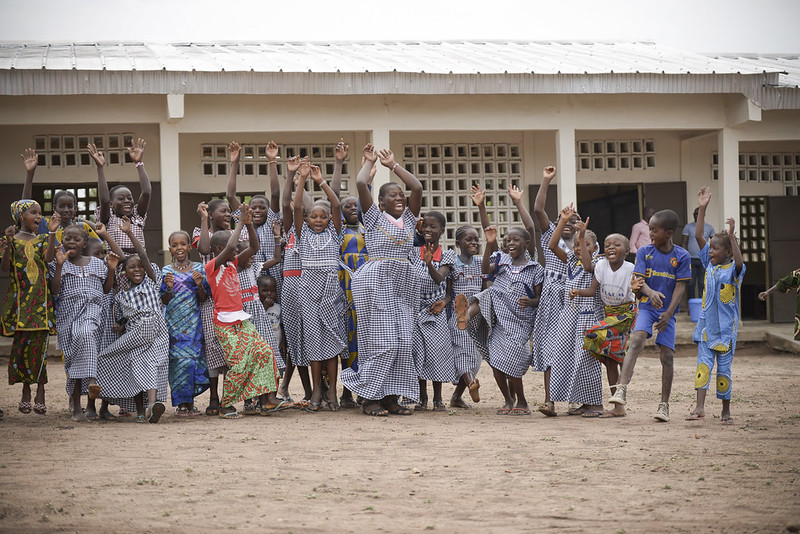
The Republic of Côte d’Ivoire, formerly the Ivory Coast, is a West African country on the North Atlantic Ocean, between Ghana and Liberia, but also sharing borders with Guinea, Mali and Burkina Faso. A protectorate of France for more than a century, the country achieved independence in 1960 but has maintained close ties with France. Ongoing civil war has plagued the country.
Côte d’Ivoire’s population of just under 30 million is highly concentrated in and around the Atlantic coast cities. Although described as “one of West Africa’s most influential, stable, and rapidly developing economies . . . [with an] increasingly diverse economic portfolio,” more than a third of the Ivoirian population (37.5%) is estimated to live below the poverty line.
Education System
The structure of Côte d’Ivoire’s education system is similar to that of most countries: six years in primary school, four years in lower secondary (middle) school and three years in secondary school. There are alternative secondary education options, including vocational schools, technical institutions, teacher-training institutions and tertiary education options. Unlike most other countries, maintaining an education system in the context of a war-torn country challenges outcomes.
Learning Poverty
The learning poverty rate, a metric initiated in 2019 by the World Bank and the UNESCO Institute for Statistics, measures the proportion of children who are unable to read a simple text with comprehension by age 10, and considers both schooling and learning. Schooling deprivation, learning deprivation and learning poverty are all related and are an early indication of risks to the overall quality of education.
The World Bank’s Learning Poverty brief for Côte d’Ivoire reported in 2022 that 83% of Ivoirian children at late primary age were not proficient in reading (learning poverty), and 78% did not achieve the minimum proficiency level in reading at the end of primary school (Learning Deprivation). In addition, 21% of primary school-aged children were not enrolled in school (Schooling Deprivation). Côte d’Ivoire’s learning poverty is somewhat lower than the average for the sub-Saharan Africa region, but 22.2% higher than the average for lower middle-income countries. The country’s expenditure on primary education ($497/child), is 11.5% below the average for the sub-Saharan Africa region and 38.5% below the average for lower middle-income countries.
Based on the World Bank’s Human Capital Index, with half of its six variables related to schools, it was estimated that a child born in Côte d’Ivoire at that time would reach only 38% of her/his potential. This was lower than the regional average and the average for lower middle-income countries.
Progress over the Past Decade
Côte d’Ivoire’s Education and Training Sector Plan 2016-2025 launched initiatives to increase access to education. Recommendations of the 2022 General Assembly on national education and literacy led to a school enrollment increase of over seven million children in 2023-2024, equally split between girls and boys. Primary school completion was 85.2%, with transition to lower secondary school of 65% and completion of 81.1%. Noted are the cultural and socioeconomic constraints that challenge success for girls and rural children. These include adolescent pregnancy and child marriage, child labor and violence. Only 11.2% of children receive pre-primary education, and low learning outcomes plague the 78.6% of children who complete primary school. More than a third of rural children (2.4 million) are not in school, compared to less than a quarter of urban children. Two million children have never been to school.
A Focus on Literacy
Less than 50% of Côte d’Ivoire’s adults are literate, with the proportion higher for men (53.7% than for women (40.5%). To address the challenge of increasing literacy rates, Côte d’Ivoire is one of 31 countries participating in UNESCO’s Global Alliance for Literacy (GAL), launched in 2016. In spring 2023, over 180 Ivoirian literacy professionals participated in an online workshop to improve the digital competencies of literacy educators. The modules and learning materials for the training were developed by GAL along with the UNESCO-led Global Education Coalition. Côte d’Ivoire was the first French-speaking country to initiate the program and one of five countries to fine-tune and pilot the modules.
Learning Conditions and Underinvestment Challenges
In February 2025, UNESCO published an updated analysis by its International Institute for Educational Planning of Côte d’Ivoire’s education sector plan for 2014-2021. Less than adequate facilities, violence in schools that results in absenteeism and dropouts, teacher absences and strikes, plus financial constraints for the poorest families all combine to continue to keep students out of school. In addition, while overall school enrollment has increased, high population growth means that many children remain out of school, have never attended or have dropped out. UNESCO found that public education spending had increased, but not as much as overall public expenditures. Since most of the education expenditures were for personnel, investment in other needs was limited.
Transforming Education: GPE
The mission of the Partnership for Education, GPE, is to “mobilize partnerships and investments that transform education systems in lower-income countries, leaving no one behind.” GPE brings together donors, multilateral agencies, civil society organizations, private foundations and the private sector to work with the government education sector.
GPE has been working with Côte d’Ivoire since 2010, with a total of 14 grants and support of almost $220 million. Four active grants as of August 2025 provide more than $114 million and are designed to address system capacity and transformatio and girls’ education. GPE’s efforts target six regions with low learning results and the highest poverty rates. Interventions include expanded preschool access, catch-up classes for out-of-school children, primary teacher training and school management committees to provide community oversight. The results of these efforts have proved so promising that the government plans to expand the initiatives nationwide. Although GPE notes continuing systemic challenges, they also report efforts toward inclusive and quality education and near-universal primary education.
A Work in Progress
Educating Côte d’Ivoire’s children means addressing cultural, social and economic challenges, all in the shadow of civil unrest. With international support, Côte d’Ivoire is tackling those challenges and achieving results that will have a long-term impact.
– Eric Paulsen
Photo: Flickr
