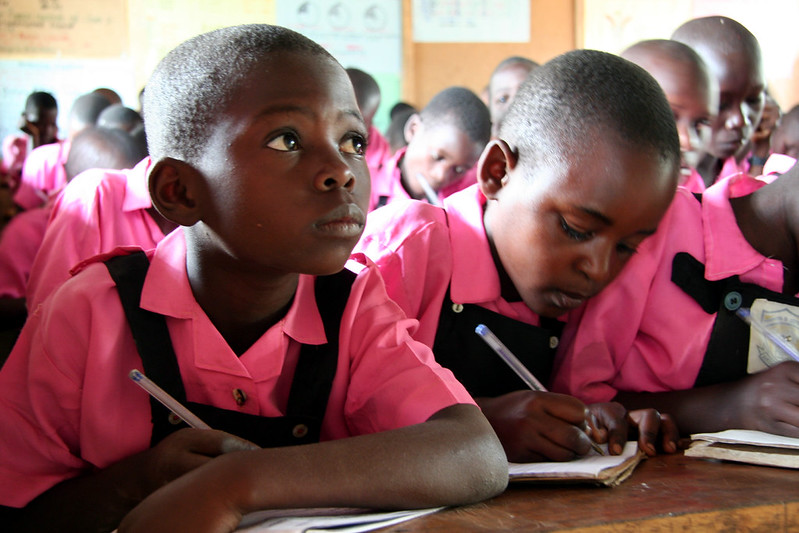
Uganda, an East African country known for Lake Victoria, the Nile and mountain landscapes, has one of the youngest populations in the world. The 2024 census counted 45.9 million people, and nearly half are children, placing enormous pressure on schools. Education is critical to national development, but Uganda still faces low secondary enrollment, teacher absenteeism and the challenge of educating almost 2 million refugees.
10 Facts About Education in Uganda
- Uganda’s 2024 census discovered that 74% of people aged 10 and above could read and write meaningfully in any language. That is progress, but it also means roughly one in four people still lack basic literacy. World Bank data similarly reports adult literacy at about 77% in 2024, showing improvement but not universal attainment.
- Uganda’s Universal Primary Education policy helped bring millions of children into school, but access has not guaranteed better learning. Older World Bank service-delivery research found serious gaps in classroom instruction, and more recent reporting continues to identify weak foundational learning as a major concern.
- The main bottleneck is lower secondary school. Uganda’s Ministry of Education says the Uganda Secondary Education Expansion Project (USEEP) aims to “enhance access to lower secondary education” for underserved groups, including refugee-hosting communities, girls and areas with limited access to public lower secondary schools.
- Uganda’s refugee policy remains one of the most open in the world. As of October 31, 2025, the Office of the Prime Minister reported 1.96 million refugees and asylum seekers in 529,083 households. Around 91% lived in settlements, while 9% lived in urban areas. Refugees came from 34 countries, led by South Sudan (55.1%) and the Democratic Republic of Congo (30.9%).
- Uganda’s Second Education Response Plan for Refugees and Host Communities (ERP II), 2021/22-2024/25, was designed to facilitate education for both refugee and host-community learners. The plan claims its goal is to improve “learning outcomes for increasing numbers of refugee children in host communities.”
- ERP II is not a small pilot. The Ministry of Education states that the plan seeks to reach an average of 674,895 beneficiaries per year over 3.5 years. This reflects a shift from emergency schooling toward a national system that includes refugees alongside Ugandan learners.
- Education Cannot Wait has worked in Uganda since 2017, assisting refugee and host-community children with inclusive education, mental health and gender equality. Its multi-year resilience program is coordinated with Uganda’s refugee education response plan.
- Teacher absenteeism continues to decrease valuable classroom learning time. Reporting on the World Bank’s Uganda Economic Update cited Service Delivery Indicators showing 23.3% of public-school teachers were absent from work, while 52.3% were not teaching in the classroom during survey visits. The report warned that “chronic teacher absenteeism compromises education quality and reduces spending efficiency.”
- USEEP includes the construction of new lower secondary schools and the expansion of existing ones. The Ministry says the project will provide learning environments that are “non-violent and supportive of girls’ education,” linking infrastructure directly to retention and completion.
- Uganda’s Education Digital Agenda Strategy 2021-2025 intends to integrate ICT into teaching, learning, assessment, sports and administration. This matters because technology can help reach remote schools and support learning continuity during crises.
Uganda has expanded primary access and built a globally recognized refugee education response. The next objective is outcomes: more students completing secondary school, more teachers present and teaching, and more refugee and host-community children learning in safe classrooms.
– Jeff Zhou
Photo: Flickr
