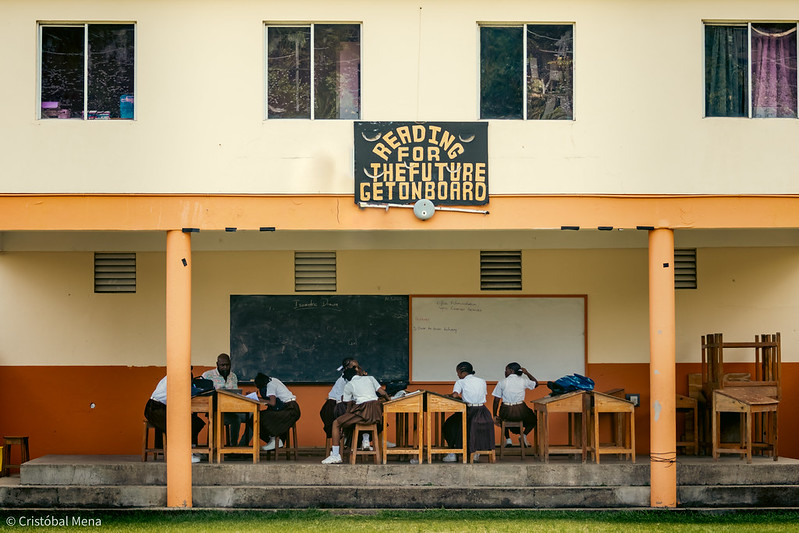
The country of Grenada comprises three Caribbean islands—Grenada, Carriacou and Petit Martinique—located between the Caribbean Sea and the Atlantic Ocean. First colonized by the French and then by Britain, Grenada become one of the smallest independent countries in the Western Hemisphere in 1974. The leftist Grenada Revolution lasted until October 1983, after which democratic elections were reinstated and remain. More than half of the country is forest and a quarter is agricultural land. The population numbers less than 115,000 and is concentrated along the country’s coast, with a third in the capital of St. George’s. https://www.cia.gov/the-world-factbook/countries/grenada/
Education System
Education in Grenada is compulsory from ages 5 to 16, with equal access. The system begins with primary school (six years), followed by secondary school (five years). Subsequent options are a two-year program or community college. https://www.aacrao.org/edge/country/grenada Accredited higher education recognizes St. George’s University and the Open University of the West Indies, in addition to two community colleges. https://accreditation.gd/higher-education-system/ Education expenditure was estimated to be 11.4% of the country’s 2025 budget and 5.1% of GDP in 2023. https://www.cia.gov/the-world-factbook/countries/grenada/
There are very limited recent statistics available for education in Grenada. The Global Economy reports 83.4% of eligible children enrolled in primary school in 2021. https://www.theglobaleconomy.com/Grenada/Primary_school_enrollment/ The World Bank reports gross primary school enrollment for random years at a declining rate, with fewer than 12,000 for 2024. https://data.worldbank.org/indicator/SE.PRM.ENRL?end=2024&locations=GD&start=1971&view=chart
The U.N.’s Sustainable Development Report classifies Grenada’s progress on SDG 4, Quality Education, as “challenges remain,” with trends noted as “stagnating or increasing at less than 50% of required rate.” The indicators reveal that the lower secondary completion rate is on track or maintaining achievement, net primary enrollment rate is stagnating and participation rate in pre-primary organized learning is decreasing. https://dashboards.sdgindex.org/profiles/grenada/
Addressing Shortfalls of Secondary Education
The Global Partnership for Education (GPE) has been partnering with Grenada for a decade, with grant support totaling over $33 million for 11 projects. Previously, GPE assisted the OECS Commission’s targeted response to the COVID-19 closure of government-funded primary schools across the region, including Grenada, with a $3 million grant to transition to distributed learning that included the provision of e-learning devices for teachers and students, teacher training related to online learning, the provision of hygiene-related supplies to 1,000 Grenada students and the implementation of an academic recovery program to lessen the loss of learning because of the school closures. https://www.globalpartnership.org/blog/oecs-gpe-covid-19-response-program-creates-community-based-employment
GPE observes that while primary education curriculum reform is underway, there is no official curriculum for lower secondary education. This lack of curriculum at the lower secondary level has led to low quality teaching and high teacher turnover rates. The GPE Partnership Compact to address this curriculum shortfall will include development of new teaching and learning materials, teacher and school leader training and improved assessment strategies.
GPE’s current priority in Grenada is “successful implementation of an enhanced curriculum and assessment strategy for lower secondary schools.” As of the end of January 2026, there are three active grants: a $10 million system transformation grant from the World Bank (2025-2029); a $5 million multiplier grant from the Caribbean Development Bank (2025-2028); and a $10 million program implementation grant from OECS (2021-2026).
https://www.globalpartnership.org/where-we-work/grenada
The Significance of Technical and Vocational Education and Training
In 2019, Grenada implemented the National Sustainable Development Plan, for the period 2020-2035. One of the plan’s eight National Outcomes is “educated, productive, highly-skilled, trained and conscious citizens.” https://observatorioplanificacion.cepal.org/en/plans/national-sustainable-development-plan-2020-2035-grenada#:~:text=The%20plan’s%20national%20outcomes%20are:%20*%20A,217%20strategic%20actions%20to%20achieve%20each%20outcome. The education sector strategy for 2023-2028 includes the development of technical and vocational education and training (TVET), building on the Grenada Council for TVET (GCTVET) established as an advisory council in 2009.
In 2023, a national TVET policy was developed to ensure that all levels of education, from pre-primary to tertiary ensured representation of TVET. https://unevoc.unesco.org/home/Dynamic+TVET+Country+Profiles/country=GRD In the government’s message endorsing the policy, the Minister of Education, Youth, Sports, and Culture underscored the goal of “improving the image of TVET so that it becomes attractive to learners as an alternative education pathway and not a second option . . . a mechanism for mastering skills through lifelong learning.” https://www.grenadanta.gd/wp-content/uploads/2024/07/National-TVET-Policy-Grenada.pdf
OECS Skills and Innovation Project. Alongside Grenada’s focus on TVET, The World Bank Group is partnering with the Organisation of Eastern Caribbean States (OECS) in the Skills and Innovation Project, of which Grenada is a part. This project supports regional collaboration in post-secondary education and innovation, especially to enhance transversal and advanced technical skills of youth, that is, cognitive and interpersonal and intrapersonal skills, as well as global citizenship and digital competencies. The project was approved in January 2024 and is expected to run for five years, with funding of $30 million credit to Grenada and Saint Lucia and $6 million in grants for the OECS Commission. The project is expected to benefit more than 40,000 post-secondary students and 120 regional entrepreneurs and firms. National colleges and post-secondary institutions will be targeted, as will the teaching of advanced technical skills. Women’s involvement and leadership will be encouraged. Ultimately, the goal is to benefit the countries’ workforces and economies.
Preparing Grenadians for the Economy of the Future
With the focus on both improving secondary and post-secondary education, including emphasis on skills training, Grenada is making headway in preparing a better-educated population for a stronger economy.
– JG Federman
Photo: Flickr
