Climate Change Refugees and the Man from Kiribati
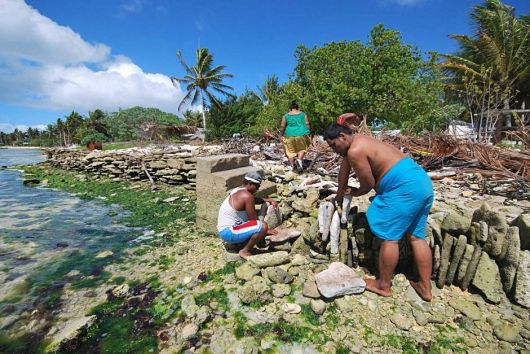
A man from Kiribati, a tiny Pacific island, has asked New Zealand to officially recognize him as a climate change refugee. New Zealand refused what was the world’s first appeal for climate change refugee status, and Ioane Teitiota now faces deportation. Teitiota had argued that rising sea levels had damaged his crops and contaminated the water supply, and that he feared a worsening situation in the future. Kiribati is expected to be three-fourths underwater in just 30 years. Its government has had to buy land from Fiji.
Climate change refugees might soon become a common place occurrence. Sea levels are predicted to rise by at least a couple of feet in the next few decades. Cities, or even countries, that lie below sea level are at high risk of being submerged. Bangladesh, for instance, would have already lost 17 percent of its land by 2050. An estimated 20 million people from this highly over-populated country are expected to become refugees. Rising sea levels could also sink all 1,200 of Maldives’ islands. Its government is attempting to work out an evacuation plan with nearby countries. Other coastal cities such as Manhattan, London, Shanghai, Bangkok, and Mumbai are at risk. Entire cultures and identities could be wiped away forever.
Droughts and desertification are increasingly destroying arable land, forcing many people to migrate further inland to already crowded cities. The Gobi Desert, for instance, expands 3,600 km square each year. Morocco, Tunisia and Libya are losing 1,000 km sq each annually. Poorer countries that depend on agriculture for both economic growth and basic subsistence are heavily impacted by the increasingly extreme weather patterns. Food security will become a serious issue for many countries when it was not before.
Although the need for one is clear, a universally accepted definition of climate refuge is lacking. The Global Governance House defines climate refugees as environmental migrants forced to move “due to sudden or gradual alterations in the natural environment related to at least one of three impacts of climate change: sea-level rise, extreme weather events, and drought and water scarcity.” Environmental migrants are defined as “persons or groups of persons who, for compelling reasons of sudden or progressive changes in the environment that adversely affect their lives or living conditions, are obliged to leave their habitual homes, or choose to do so, either temporarily or permanently, and who move either within their country or abroad” by the International Organization for Migration.
Last year, 36 million people were displaced by natural disasters. Of this number, an astounding 20 million were climate change refugees. António Guterres, UN High Commissioner for Refugees, predicts that the number will increase rapidly, and not just because of changes in weather in climate. The shortage of food and clean water will lead to “resource wars,” as they are called in popular culture. Increased competition for water, food and grazing lands will lead to conflict. A recent study predicts that the probability of civil war will increase in Africa by more than 50 percent by 2030 as compared to 1990.
– Radhika Singh
Sources: UNHCR, Telegraph, International organization for Migration, Global Governance House, National Geographic
Photo: ABC
