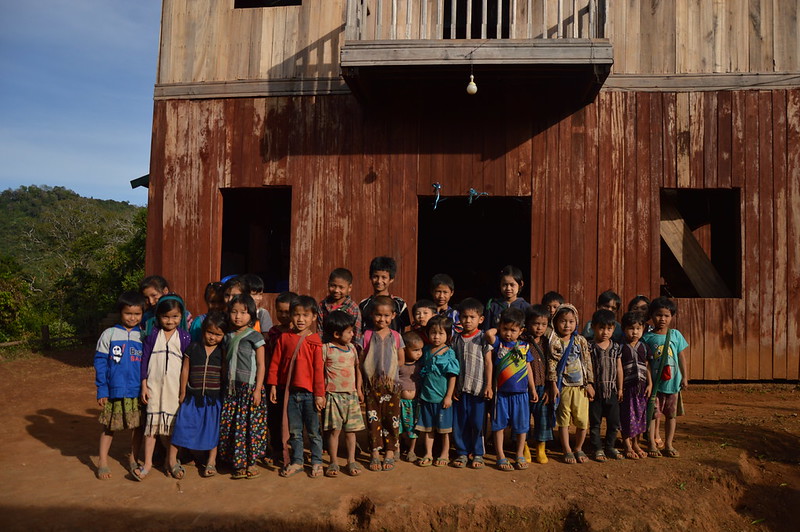
The Republic of the Union of Myanmar, known as Burma until 1989, is a Southeast Asian country located on the Bay of Bengal and the Andaman Sea between Bangladesh and China, additionally bordering Laos, Thailand and Cambodia. British control began early in the 19th century, and Burma remained a British colony from 1937 until its independence in 1948. Its ethnically diverse population of over 54.5 million (2024) comprises 135 ethnic groups, predominantly rural.
Myanmar’s people continue to be the victims of both manmade and natural crises. In December 2025, OCHA (the U.N. Office for the Coordination of Humanitarian Affairs) described Myanmar as the fourth most dangerous country for civilians, only second worldwide in terms of conflict intensity, which involved more than half of its population. This is in addition to recurrent natural disasters, including a devastating 7.7 magnitude earthquake in March 2025, whose destruction threatened food security for two million people. These crises have affected an estimated 3.6 million people.
National Education System
Myanmar’s Ministry of Education has primary responsibility for the national system of education, which is “to provide basic education equated with livelihood and within the reach of all.” The 11-year system is a 5:4:2 structure—primary, middle and high school. The ministry’s seven components include departments of basic education (including teacher training); higher education (universities and colleges); and technical, agricultural and vocational education; as well as examination, research and language functions. The ministry reported that the opening of the 2025-2026 academic year saw over 5.8 children in attendance at government basic education schools, monastic schools and private institutions. The government provided free textbooks, exercise books and stationery to all students, as well as free uniforms to kindergarten and primary school students.
Crises and Challenges
The Geneva Global Hub for Education in Emergencies reported in December 2025 that, as a result of school attacks, landmine contamination, disasters and economic decline, Myanmar is facing a severe education crisis. Almost seven million children (53%) are not in school—one of the highest rates in the world. Challenges include attacks on schools, as well as their use by the military, resulting in injuries and fatalities among both children and teachers. These conditions have left families afraid to send their children to school. Economic insecurity has also increased the need for child labor, further disrupting education. Nevertheless, despite these challenges, the World Bank reported a 94% literacy rate for 2020.
CESVI Response
CESVI, an independent humanitarian organization based in Italy, has been working with the European Union to address child protection in Myanmar in areas affected by conflict and to ensure education continuity. Its CO-LEARNS Plus project has been operating since October 2024 in two Myanmar regions to strengthen community engagement and local resilience model of education. More than 12,000 children participated in one of 100 community learning centers that enabled them to catch up on missed school years. Adolescents and older young people, often ignored in such efforts, were also included. CO-LEARNS included educational materials and tools for recreational activities, as well as training and support for 300 teachers and community tutors.
Education Cluster Bridging Strategy
Save the Children and UNICEF are co-leading the countrywide Myanmar Education Cluster, initiated in 2021. The aim of the cluster is the coordination of education stakeholders as part of a multisector approach to the country’s ongoing humanitarian crises. The current two-year strategy (January 2026 – December 2027) recognizes the significance of education access and quality for displaced and returning households, exacerbated by the reliance on volunteer teachers in many places. Attention is placed on psychological and psychosocial support, as well as advocacy for not targeting schools, so that they can be safe, protective places for children. The plan targets 1.1 million out of 3.5 million people in need, prioritizing 614,000 people. A longer-term goal is that, where “feasible and safe,” there is increased leadership of local NGOs and community-based organizations, including youth-led and women-led organizations. The intention is for the community-based systems to become “key custodians of education continuity” where there is limited access to external resources.
The Future
As the CESVI and Education Cluster models demonstrate, both international support and local engagement are the path to strengthened education systems in Myanmar.
– Christina Cho
Photo: Flickr
