Against All Odds – Supporting Women’s Education in Afghanistan
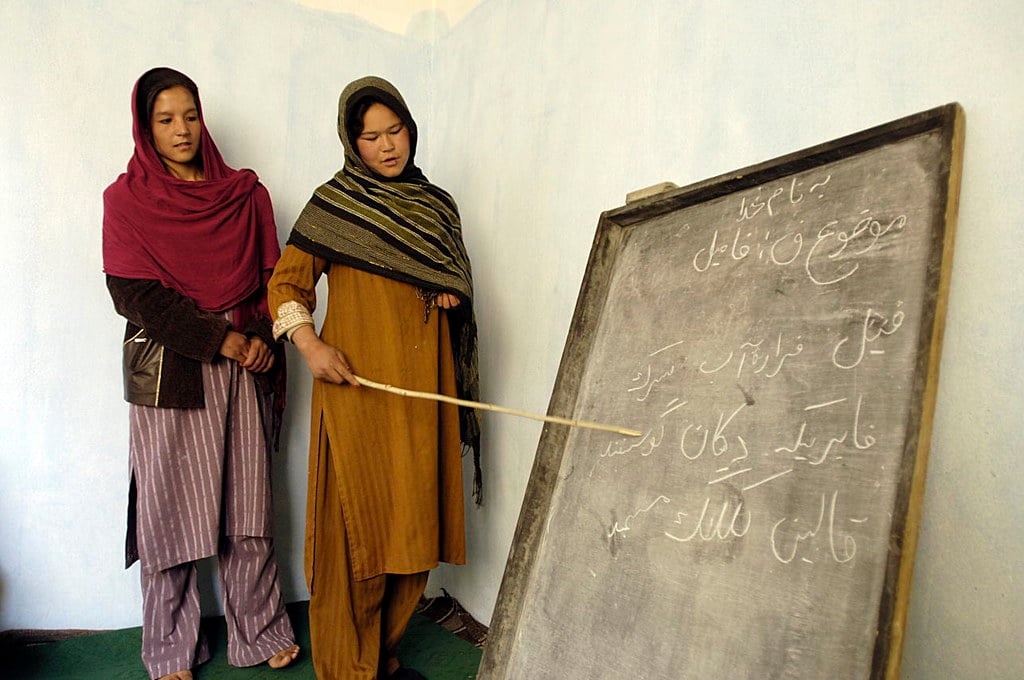
Education for girls and women in Afghanistan has seen a dramatic reversal since the Taliban returned to power in 2021. During the previous two decades, access to education had expanded considerably. By 2021, almost one million girls were enrolled in secondary education. Since then, girls have been prevented from attending education beyond grade six, and women have been excluded from attending university since December 2022. Afghanistan is now the only country in the world where secondary and higher education is closed to girls and women.
This problem continues to grow in both scale and scope. UNICEF reported in August 2026 that more than 2.6 million girls had been denied secondary education since 2021. An April 2026 UNICEF analysis estimates that in 2024, 3.8 million girls aged 7–18 were out of school, including more than 2.6 million adolescent girls. Such restrictions illustrate the scale of the challenge facing aid organizations in providing women’s education in Afghanistan.
Efforts by UNICEF and UNESCO
UNICEF is one of the largest organizations supporting education in Afghanistan. For children unable to attend school, UNICEF supports community-based education, temporary learning spaces and other forms of alternative education. These programs allow children to continue learning outside formal school settings.
UNICEF also supports teachers, learning materials and education infrastructure. Its programs are particularly important for children living in rural or conflict-affected areas, where access to formal schools can already be difficult. In January 2026, UNICEF and UNESCO reported that approximately 2.2 million adolescent girls had been prevented from attending secondary school and emphasized the need to maintain access to primary education and alternative learning opportunities.
UNESCO has similarly developed community-based education, literacy, skills-development and vocational programs that can provide women’s education in Afghanistan. These are particularly important for women who have been excluded from universities and other formal education. UNESCO reported in 2026 that nearly 70,000 learners had benefited from its programs, with women representing approximately 73% of participants.
Local Initiatives and International Support
These initiatives provide an important educational lifeline, but they cannot completely substitute for formal secondary schools and universities. A girl studying through a community program does not necessarily receive the same qualifications or opportunities as someone attending a recognized secondary school.
Alongside large international organizations, Afghan-led groups have developed more discreet methods of keeping girls and women in education. Some operate virtual classrooms, while others provide small-scale community or underground education. These organizations can be difficult to identify publicly because revealing the identities of students, teachers or locations may expose participants to risks.
The Initiatives and Their Accomplishments
An Afghan activist and former teacher established Afghanistan Education Action (AEA) following the Taliban takeover. Its online school was established in 2021 and operates undercover due to restrictions on girls’ education. The school currently reports around 820 students attending daily lessons and more than 84 subjects. These include mathematics, science, computer science, English, Persian literature, art, philosophy, women’s health and calligraphy. Approximately 70% of its students are women and girls. Its international school also helps students work toward formal qualifications.
Other Afghan-led organizations use similar approaches. LEARN Afghan, for example, operates digital and community-based education programs, while Gahwara has developed virtual and in-person educational opportunities for girls and women. The discreet nature of some of these programs means that publicly available information about their scale is necessarily limited.
U.K.-based charity Children on the Edge (COTE) has played an important supporting role in Afghanistan Education Action. Following the establishment of the online school, Children on the Edge helped AEA develop its organizational structure, fundraising and administration. It also supported AEA in becoming an independent U.K.-registered charity and helped establish additional educational programs.
Children on the Edge reports that AEA’s online school provides daily education to more than 800 students. AEA reports more than 84 subjects and a network of more than 400 volunteer teachers and administrative staff. This type of support is significant because it attempts to go beyond simply providing lessons. AEA’s programs aim to preserve a pathway toward formal qualifications, higher education and international scholarships.
Community-Based Learning and Future Prospects
Education Cannot Wait (ECW), the UN global fund for education in emergencies, has also supported education programs in Afghanistan. Its approach focuses heavily on community-based learning, enabling children excluded from education to continue studying. Programs supported through ECW have reached hundreds of thousands of children, with girls making up a substantial proportion of those helped.
Large organizations such as UNICEF and UNESCO provide community-based education and support for primary-age children, while organizations such as AEA, LEARN Afghan and Gahwara attempt to reach older girls and women who have been excluded from formal education. Children on the Edge demonstrates how smaller international charities can support Afghan-led initiatives with funding, administration and international connections.
Ultimately, organizations working to provide women’s education in Afghanistan face many challenges which demonstrate both the importance and limitations of international intervention. Organizations operating on the ground help provide education, qualifications, technology and hope to thousands of girls, but they do not provide the same scale or recognition as a functioning national education system could. The long-term solution therefore remains the restoration of girls’ access to secondary and higher education, while organizations such as UNICEF, UNESCO, Afghanistan Education Action and their partners continue to provide alternative routes to learning in the meantime. Therefore, continued funding of such programs is vital in order to bridge that gap while restrictions on formal education for Afghan women remain.
– Mark Hooley
Mark is based in Edinburgh, UK and focuses on Politics for The Borgen Project.
Photo: Flickr
