The Links Between Disability and Poverty in Poland
 There exists a significant correlative link between disability and poverty in Poland. In 2021, the most severely disabled people in Poland faced a 33.5% risk of falling into poverty, which is double the poverty rate of the general Polish population, the European Semester 2020-2021 country fiche on disability in Poland reveals. In recent years, the government has offered benefits for the families of people with severe disabilities. However, activists argue that the benefits must be expanded to support the high costs of living in the nation.
Government Initiatives
In 2018, the Government of Poland launched a program called “Accessibility+,” which is set to last until 2025. The program allocated 23.2 billion zlotys to fund special schools and general welfare. It also established the Accessibility Council as “an advisory body to the Minister for Regional Development.” In theory, this council pushes for laws that mandate high accessibility standards in all areas of life, such as health care, public transportation and public institutions.
For example, public transportation services must provide tactile paving, braille maps and easy passage for wheelchair users. Accessibility+ is a significant achievement for the Polish disability movement because the first step of integrating those with disabilities into the economy is to ensure their safety in public. In addition, the government has introduced measures, such as the 2019 Solidarity Fund for Persons with Disabilities, to provide “social, professional or health support for persons with disabilities,” the government website says. All of these measures serve to address the link between disability and poverty in Poland.
Activist Protests in 2018 and 2023
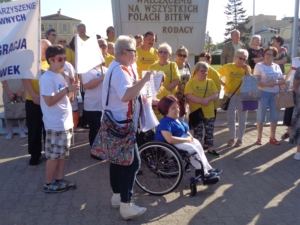
Political Critique tells the story of Iwona Hartwich, the mother of 25-year-old Kuba who has cerebral palsy and is one of nearly 300,000 severely disabled persons in Poland who cannot live independently. Hartwich is a Civic Coalition opposition party member and a key organizer of protests demanding greater state care for those with disabilities. In 2018, she led demonstrators, mostly parents of disabled children, to occupy the Sejm (the lower house of the Parliament) for 38 days. In response to this demonstration, the government unveiled Accessibility+, the Solidarity Fund and other initiatives to help disabled people.
But, protesters and activists criticize the government initiatives in response to the 2018 protests as surface-level and insufficient. Hartwich notes that while the government allocated 33 billion zlotys to the Solidarity Fund, households with disabled people have received only 12 billion zlotys. In March 2023, demonstrators led by Hartwich again occupied the Sejm.
As of March 1, families of adults incapable of living independently due to severe disabilities received an allowance of 1,588.44 zlotys ($378.9) a month before tax, which is less than half the statutory minimum wage of 3,490 zlotys ($832.56). After tax, this allowance became 1,217 zlotys ($290.32). In light of record inflation and unemployment, this allowance amounts to what Hartwich has dubbed a “starvation pension.” To properly address the link between disability and poverty in Poland, protesters are calling for their disability benefits to increase to the level of Poland’s minimum wage. In addition to better benefits, demonstrators are fighting for the right to keep their benefits while employed. As it stands, the government denies allowances to employed caregivers.
New Government Proposals in 2023
In light of the recent grassroots campaigns concerning the relationship between disability and poverty in Poland, the government unveiled a set of proposals in 2023. This represents a “change in logic” in how it assists households with disabled family members. The proposals place a newfound emphasis on the autonomy of disabled adults by giving benefits specifically to them, not to their caregivers. This could cultivate independence as the adults could then use the money to pay for their own care instead of relying on their parents. This change of logic more closely aligns with the U.N.’s Convention on the Rights of Persons with Disabilities, which Poland ratified in 2012 and which emphasizes the individual autonomy of people with disabilities.
The Power of the Polish Disability Movement
Grassroots activists lead the way in raising public awareness about the condition of people with disabilities. For example, the group Protest 2119 played a role in organizing the 2023 occupation of the Sejm. The number “2119” references the 2119 zlotys afforded to families per disabled child. The group’s Sejm demonstration forced the public to reevaluate not only the state’s treatment of disabled people but also its own ableist prejudices, which affect hiring and play a crucial role in the link between disability and poverty in Poland.
Campaigns raise international awareness as well. The U.N. Committee on the Rights of Persons with Disabilities (CRPD) monitors countries’ implementation of the Convention. In response to the 2018 protests, the CRPD conducted an investigation of the Polish government’s treatment of people with disabilities. The committee reaffirmed the conclusion of grassroots campaigns that people with disabilities in Poland are “still not fully enjoying their human rights.” The committee did, however, commend Poland’s adoption of the 2018-2025 Accessibility+ program. Groups like the CRPD are instrumental in pressuring the Polish government to adhere to international disability rights standards.
What is Ahead?
Activists like Iwona Hartwich continue to advocate greater state care for those who cannot live independently. Each wave of demonstrations demands attention from the public, the international community and those with the power to implement social policy. With persistence and perseverance, the activists have seen success in improving the material conditions of people with disabilities.
– Eric Huang
Photo: Wikimedia
