Eliminating Food Scarcity in Nigeria With Mechanized Agriculture
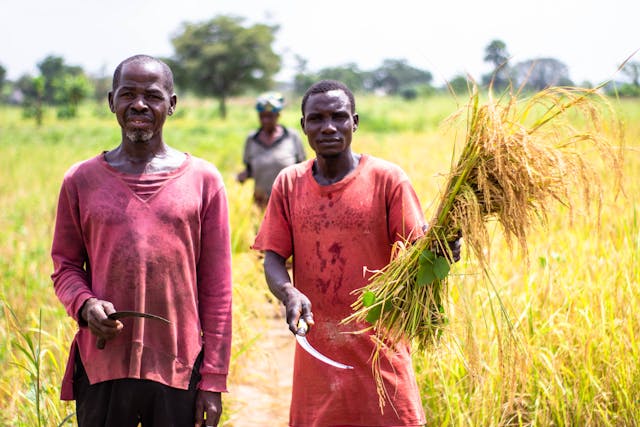 Agriculture is the lifeblood of Nigeria. The country has vast fertile land, perfect for raising livestock and cultivating crops such as yams, maize and cocoa. Agriculture makes up more than 20% of the country’s GDP and farming is the number one source of employment. Nigeria’s agricultural output potential is massive, but it is rarely realized due to high poverty rates.
However, this is changing. Through recent programs, mechanized agriculture is reaching Nigeria’s hardworking farmers, enabling them to vastly increase their yields. With the continued success of these programs, food scarcity in Nigeria is set to decrease exponentially.
The Unique State of Nigeria’s Agriculture
Out of Nigeria’s population of 232 million, more than 60% are multidimensionally poor. This means that farmers are forced to operate on a community scale rather than expanding their work to a commercial level. About 80% of Nigeria’s farmers operate on this smaller scale and still, they account for more than 90% of agricultural output.
Usually, farmers in Nigeria can barely provide for themselves and their communities. Their work is essential, but never enough. The domestic demand for farm products in Nigeria is so large that, despite being Africa’s top rice producer, the country still imported 2.9 million tons of rice in 2014. As a result of poverty, Nigerian farmers rarely have access to basic modern farming inputs, such as fertilizer, pesticides or mechanization, including tractors.
How Mechanized Agriculture Is Making a Difference
In 2018, a deal was made between John Deere, the American tractor company, its distributor, the Tata Group and Alluvial, a Nigerian agricultural company that works with smallholder farmers. Together, the two companies formulated an agreement that has been revolutionary for Nigeria’s small farmers.
At Alluvial’s request, John Deere has agreed to begin leasing 300 tractors to smallholder farmers of Nigeria within the Niger Delta region, an area of significant food scarcity that is home to more than 100,00 farmers. These 300 tractors are now available to lease at only $100 per acre of land for use in their everyday farming duties.
With this project, Alluvial’s goal is to unite Nigeria’s smallholder farmers into a commercial workforce. Furthermore, the aim is to supply them with the materials needed to expand their agricultural operations. Alluvial’s owner, Dimieari Von Kemedi, hopes to raise these farmers to a level where their crops can be sold across Nigeria and, eventually, beyond Africa.
What Is Next?
The Nigerian government has begun investing more in its farmers. In May of 2018, the government bought 10,000 more tractors to lease to farmers. Alluvial’s initiative has already inspired more change than was ever anticipated.
And even now, the initiative continues. Nigeria’s federal government has been continuously purchasing more tractors and other farming equipment to sustain agricultural growth. In September of 2025, the government distributed 2,000 more tractors and 9,000 other pieces of machinery.
Many people in Nigeria are still going hungry and farmers are still struggling to keep up with demand. But this initiative, which began in 2018, has introduced a potential solution that is still being implemented today. As long as projects like this continue, positive change is inevitable.
– Lucas Cain
Lucas is based in Pittsburgh, PA, USA and focuses on Good News and Technology for The Borgen Project.
Photo: Pexels
