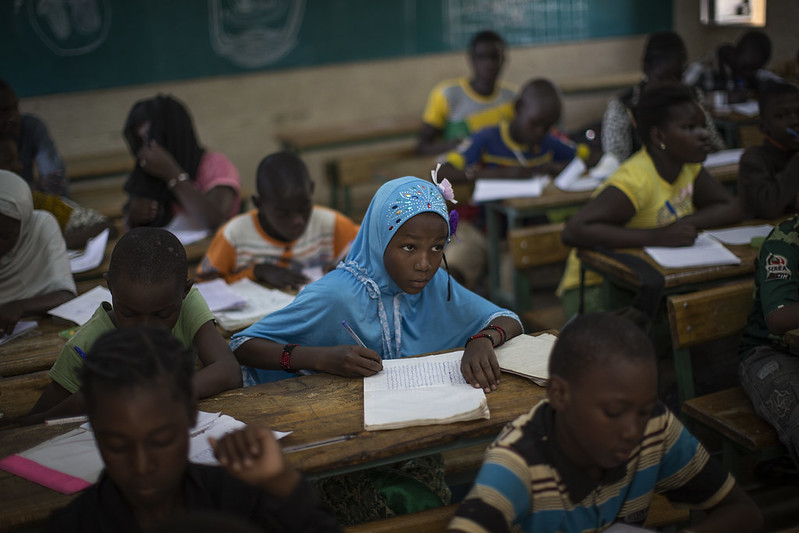
Education has been a constitutional right in Mali since 1993, and the country has implemented successive reform plans to expand access and improve quality. However, more than a decade of insecurity, displacement, and economic strain has significantly disrupted schooling, especially in central and northern regions. Today, the key question is not whether Mali recognizes education as a right, but whether children, in particular girls and displaced students, can actually stay in school and succeed.
According to UNICEF, Mali faces one of the largest out-of-school populations in West Africa. As of 2023, over 2 million children were estimated to be out of school, driven by poverty and school closures. Armed groups have targeted schools, teachers and students, leading to the shutdown of thousands of classrooms in affected regions.
Enrollment Gains but Completion Struggles
Despite instability, Mali has achieved long-term gains in enrollment. World Bank data show that the primary school gross enrollment rate exceeds 80%, a notable increase compared to rates in the early 2000s. Enrollment does not necessarily equal completion. UNESCO data indicate that primary completion rates are substantially lower than enrollment, reflecting dropout, repetition and conflict-related disruption.
Secondary access remains even more limited. According to the World Bank, Mali’s secondary gross enrollment rate is below 50%, with stark rural-urban disparities. Many rural communities lack lower and upper secondary schools, and indirect schooling costs place a burden on poor families.
Students who complete lower secondary must pass the Diplôme d’Études Fondamentales (DEF) examination. At upper secondary, students sit for the Baccalauréat, which determines eligibility for university. However, exam performance has fluctuated sharply in recent years due to teacher strikes and political instability. National reporting in 2023 showed Baccalauréat pass rates below 30%, highlighting ongoing quality challenges.
Challenges and Solutions
Gender disparities pose a critical challenge to the Malian education system. UNICEF reports that girls are significantly more likely than boys to be out of school, particularly in rural areas where early marriage and domestic responsibilities limit attendance. According to the World Bank, the female lower secondary completion rate remains far below that of boys.
Mali also continues to face one of the highest child marriage rates globally. UNICEF estimates that 53% of women aged 20–24 were married before age 18, a factor strongly correlated with school dropout. Education officials acknowledge the link. As UNICEF Mali has emphasized, “Keeping girls in school is one of the most powerful tools to delay early marriage and reduce poverty.”
Recognizing that traditional academic pathways do not serve all students, Mali, alongside partners like the World Bank, has expanded investment in technical and vocational education and training (TVET). These development projects aim to align vocational programs with labor-market demand in agriculture, construction and services.
Several NGOs are working directly with communities to keep children learning despite insecurity. Save the Children runs education-in-emergencies programs in Mali, establishing temporary learning spaces and providing teacher training in conflict-affected areas. Meanwhile, Ouelessebougou Alliance continues its long-term partnership model, building classrooms and supplying materials in rural villages to boost attendance and transition to government-supported schooling.
Mali’s education system has broadened access over the past two decades, but conflict and poverty continue to undermine outcomes. Enrollment rates tell a partial success story; completion rates, exam performance and gender gaps reveal how fragile that progress is. Sustained investment in safe schools, teacher retention, girls’ protection and vocational pathways will determine whether education can truly function as Mali’s most powerful poverty-reduction mechanism.
– Jeff Zhou
Photo: Flickr
