Children on the Streets of Bangkok
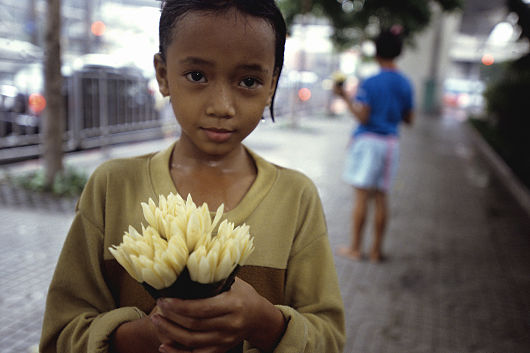 Most beggars in Bangkok are not from Thailand. They are migrants from neighboring countries, such as Cambodia or Burma, who are drawn to the city’s lucrative begging opportunities. These beggars must accept a high level of risk when they travel to Thailand; many are thrown in jail and then deported in a worse state than before. But the biggest issue arises when they bring their children with them. These children are often abandoned and left to work on the streets of Bangkok. They are at risk of being abused and exploited, are often unhealthy and are in danger of being hit by cars or motorcycles.
There are more than 20,000 street children in Thailand’s major urban areas. In a single day, a child can earn 300 baht ($10) to 1,000 baht ($30) – much more than the amount a Cambodian or Burmese living in poverty makes back home. In Phnom Penh, for instance, scavenging rubbish all day will only earn a child 16 baht ($0.50).
Cambodians make up around 80 percent of Thailand’s child beggars. Cambodia is one of the poorest countries in the world and half of its population is children.
Beggars who are from Thailand usually hail from the northeast Isan region, where 40 percent of the country’s poor comes from. Their parents come to Bangkok to find work, usually as motorcycle taxi drivers or construction workers. When they have children, they realize they cannot afford to take care of them. Distrustful of the government-run orphanages, many simply abandon their children in the hands of babysitters, hoping they will find a home there. However, these children are often made to work on the streets to earn some money for their upkeep, according to chairwoman Darat Pitaksit of the Young Women’s Christian Association (YMCA) in Bangkok, an organization that works with underprivileged children.
Because going to school is mandatory until the sixth grade, most Thai children manage to attend at least primary school. Secondary school attendance in Bangkok, however, drops by 20 percent. Despite it being the richest area of Thailand, rates of attendance are lower in Bangkok than anywhere else in the country because of the presence of migrant workers’ children and the lifestyles they are made to lead.
Contrary to common perception, street children, both from Thailand and neighboring countries, do not fall into crime, drugs, or other illicit activity. “Thai children are raised to respect their elders,” Pitaksit says. “In addition, the belief in karma helps them to be more accepting of their hardships in life.” Similarly, Cambodian children would often rather beg on the streets than go to school, says Chantana Sueprom, a staff member of the UNICEF supported NGO Friends International. They feel it is their duty to help their parents earn money.
– Radhika Singh
Sources: Reuters, UNICEF, Asian Development Bank
Photo: Jimmy Lam Photography
