Time Poverty in Kenya: The Invisible Burden of Unpaid Care
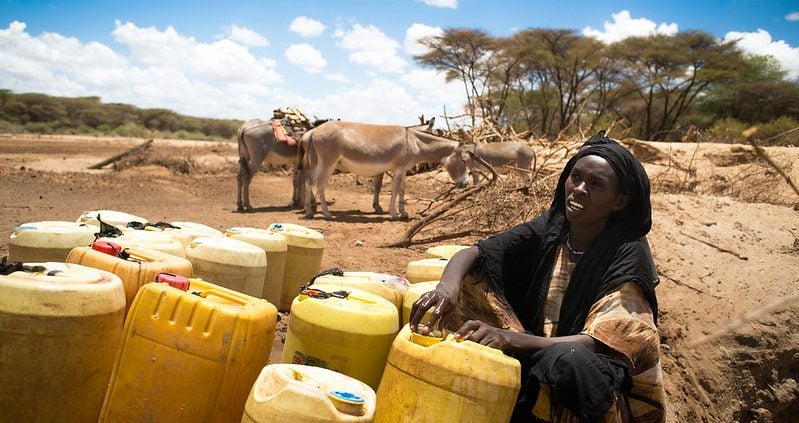 Before the sun rises, a woman in Western Kenya is likely already carrying water to her household. By the time everyone else wakes up, she has spent hours on unpaid labor, work that is expected but not assigned.
In 2023, women in Sub-Saharan Africa spent 16.6% of their day on unpaid care and domestic work, compared to 5.9% for men, nearly three times as much. Responsibilities such as water and firewood collection, caregiving, cleaning and cooking necessitate hours that women could spend more productively elsewhere. For example, a lack of basic household water and sanitation costs the global economy an estimated $260 billion in unrealized productivity.
This is what many scholars call time poverty: a state in which an individual has little to no discretionary time after spending hours on survival tasks and domestic labor. Eliminating time poverty in Kenya is not just about saving hours; it is about who those hours belong to once they are saved, and whether that person is finally free to spend them on education, wage work, rest or civic life.
Oxfam Canada’s “Time to Care” Project
In 2023, Oxfam Canada launched Time to Care (TTC), a six-year initiative headquartered in Nairobi, Kenya. Oxfam Canada partnered with the Center for Domestic Training and Development and Youth Alive Kenya to operate across Nairobi, Mombasa, Kiambu and Nakuru counties. By improving the conditions of paid and unpaid work, the program aims to directly benefit nearly 6,000 people, with more than two million people reached indirectly. These numbers include small-scale farmers and women-led households.
Poverty also varies drastically across Kenya. In 2022, the national poverty headcount rate was 39.8%, while Turkana County recorded an overall poverty rate of 82.7%. This figure was just 16.5% in Nairobi City and 19.9% in Kiambu. These disparities are important for understanding Time to Care because the project operates across counties where economic circumstances differ considerably. A simple national poverty figure can obscure the changing conditions of time poverty in Kenya.
Two pillars anchor the project, one focused on worker protections and one on behavior change:
- Care worker protections: This pillar aims to strengthen the skills and knowledge of paid care workers so they can defend their rights to decent work. TTC also engages the employers of domestic workers to raise awareness of those rights.
- Social norms change: This pillar focuses on increasing awareness and promoting a positive shift in cultural norms that recognize the value of paid and unpaid care work. The project has the explicit goal of sharing the burden of care work across Kenya.
For paid care workers, stronger knowledge of labor rights and improved working conditions can promote better economic security. Changing conditions of time poverty in Kenya can give women more opportunities to pursue paid employment, education or other income-generating activities. However, even when a woman gains time, it does not mean that the time stays hers. A daughter might quietly absorb a chore her mother no longer has time for, meaning the underlying inequality has not moved, only changed shape. By addressing both the conditions of care work and the unequal distribution of unpaid care, TTC takes a “rights-based, feminist, and intersectional approach” to challenging who society expects to do the work, and expanding women’s ability to benefit from economic opportunities.
What Time to Care Has Achieved So Far (2024-2025)
- Advocated directly to 1,965 people – 1,452 women and 513 men
- Completed two capacity-strengthening sessions with paid care worker groups
- Trained 89 care workers on life skills and competencies related to decent work and the right to live free from violence
- Reached 135 employers through a Community of Practice on responding to the rights and needs of paid care workers
- Partnered with social media influencers to reach younger demographics
The program is only halfway through, so Oxfam Canada has scheduled a mid-term evaluation for late 2026. While this is not a completed success story, Oxfam Canada offers something incredibly useful: a live test of whether shifting social norms can change who does the work, not simply how long it takes.
When women spend nearly three times as much of their day on unpaid care work as men, time is a scarce resource. There are numerous nonprofits dedicated to providing life-saving infrastructure, like Engineers Without Borders Kenya and Habitat for Humanity Kenya. While these are undoubtedly important, treating time poverty in Kenya as secondary to income poverty misses half of the story.
The purpose of Time to Care is not to find out whether a well or a mill saves hours; evidence already shows it does. It is discovering whether those hours actually redistribute toward the women who lost them, or simply get absorbed elsewhere in the household. That is the harder problem, and it is the one Time to Care is trying to solve.
– Julia Sanders
Julia is based in Fitchburg, WI, USA and focuses on Good News and Global Health for The Borgen Project.
Photo: Flickr
