Cartel Crisis: Addressing Child Poverty in Ecuador
 In recent years, Ecuador has become one of the world’s largest trader of cocaine, resulting in widespread gang violence and instability. At the same time, 45% of its under-14s are living below the poverty line, making them highly vulnerable to joining gangs and perpetuating the crisis. The World Bank and Cross International have administered aid programmes designed to address child poverty in Ecuador during its cartel crisis.
Overview of Ecuador’s Cartel Crisis
Ecuador is a small and highly biodiverse South American country bordering the world’s two leading producers of cocaine: Colombia to the north, and Peru to the south. Historically, Ecuador has been considered one of the more stable Latin American nations, largely evading the well-documented cartel-driven violence that has plagued its neighbours.
However, in the aftermath of the COVID-19 pandemic and despite not producing the drug itself, around 70% of the world’s cocaine now passes through Ecuador, BBC reports. Large criminal organizations from Albania, Mexico and Colombia have colluded with local gangs to control Ecuador’s ports and their shipping routes. Devastating violence has followed: there were 781 murders in January 2025 alone.
President Daniel Noboa — re-elected in April — has instigated a State of Emergency, including a nightly curfew, on several occasions, and has promised to crack down on the violence. Yet even with notorious gang leader Fito being extradited to the U.S., the violence is continuing and spreading inland: on 28 July 2025, 17 people were shot dead in the small town of El Empalme.
Child Poverty in Ecuador
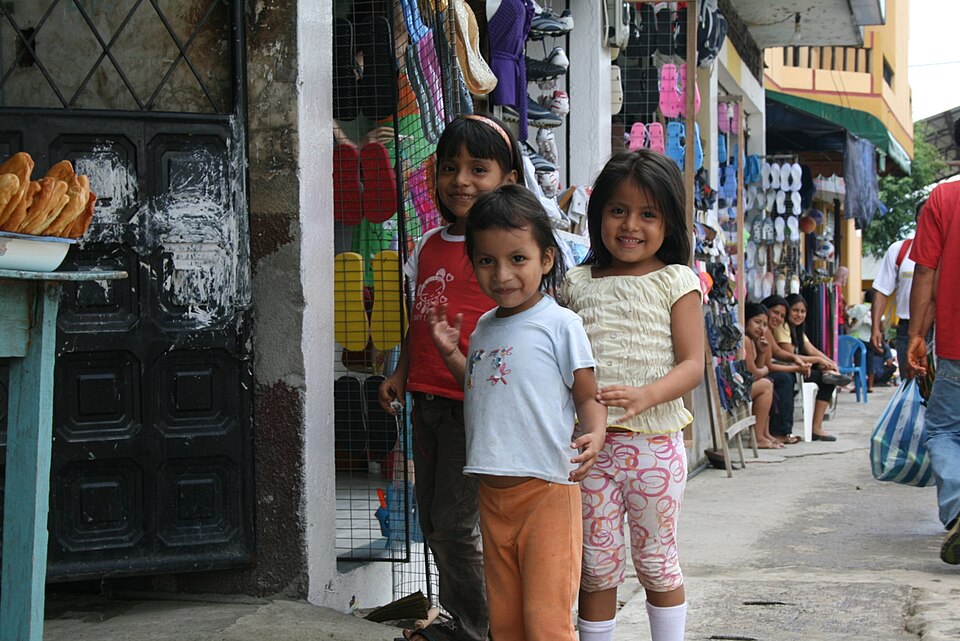
Child poverty is a major social issue facing Ecuador, with the World Bank reporting that 45% of under-14s live below the poverty line. The implications make for grim reading: malnutrition affects 23% of Ecuadorian children; many, especially in rural areas, cannot access education; several fall victim to child sexual abuse. Poorer children in cities often have to work on the streets to support their families, and schooling itself is often so poor that it fails to help those from disadvantaged backgrounds out of poverty.
Child Poverty and the Cartel Crisis
Inner-city slums such as those in the capital, Quito, and in the major port city of Guayaquil, are perfect targets for criminal gangs and a focal point of Ecuador’s cartel crisis. Many have been branded “breeding grounds” for child and adolescent gang violence, whereby children growing up in overcrowded houses and unsafe neighbourhoods, and who lack strong support networks, develop a distorted concept of violence as a normal element of home life.
Criminal gangs seek to exploit young people’s lack of social and economic opportunities, instilling fear in impoverished communities. Some inner-city schools struggle with “micro-trafficking”, whereby older children recruit younger children into gangs within the school grounds. Teachers report feeling afraid of teaching children whose parents are gang members, for fear of drawing their attention.
Addressing Child Poverty in Ecuador’s Cartel Crisis
Two significant aid programmes are seeking to address child poverty during Ecuador’s cartel crisis. In February 2025, the World Bank committed to a $110 million U.S.-funded “Social Safety Net” program, focusing on improving child development and tackling the most significant dimensions of child poverty in Ecuador. Among its interventions are cash transfers for households with children under 3 years old and cooperative work with Ecuador’s Ministry of Health to increase the provision of nutrition services across the country to address child malnutrition.
Additionally, Cross International provides direct aid to children living in poor inner-city slums. Cross International provides food and academic support for primary schools to support families who do not have the time or resources to feed or academically assist their children. For those in secondary school, Cross International have innovatively established a night school, acknowledging those children who have to work in the daytime to support their families, according to its website. These measures explicitly aim to support at-risk children living in poverty during Ecuador’s cartel crisis.
Although the situation in Ecuador is undeniably bleak, these aid schemes are providing vital support in addressing child poverty and reducing the risk of Ecuador’s cartel crisis engulfing many more young people.
– Joseph Webb
Joseph is based in Norwich, UK and focuses on Politics for The Borgen Project.
Photo: Wikimedia Commons
