A Framework for Change: Akokán Fighting Poverty Through Art
 In the heart of Havana is a mural of a small boy, his face covered with a bandana, watching over the streets of the old town. As the colonial buildings are collapsing around him, it is difficult not to feel empowered by the boy’s innocent yet vigilant eyes and the word “CORAJE” featured above his head.
While Cuba has a history of overcoming challenges, these challenges have become more and more frequent in recent years. Since the pandemic in 2019, the Cuban economy has struggled to bounce back, with inflation recently estimated to be at 30%. However, spiralling prices are not the only worry for Cubans. Powerful storms regularly hit the island, leading to blackouts due to the outdated Soviet-era power grids. As such, food insecurity has become a big concern on the island, with some estimating that as much as 37.8% of the population is food insecure.
The sugar industry, for example, has declined significantly since 1959, with more than 160 mills reduced to just 20 in 2024. This has resulted in the island importing a product it once dominated. And, with a population of 8.62 million (2023) that shrank by 18% in just two years, brain drain and an aging population have significantly impacted economic output.
The Role of Art in Cuba
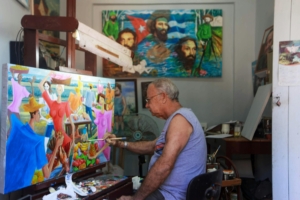
Since the Special Period in the 1990s, resilience has become a core element of Cuban identity. Despite recent government efforts to limit artists who seek to raise awareness about the economic difficulties on the island, art has become a vehicle for hope and innovation in Cuba.
What makes Cuban art distinctive is its tendency to use daily objects and turn them into thought-provoking works that deal with themes of struggle and paradox. Yoan Capote, for example, uses oil-based paints with fishing hooks to explore the theme of migration in Cuban culture and the dangers associated with crossing the sea.
Beyond the artwork, the galleries encompass the Cuban spirit of renewal, as the popular Fábrica de Arte (Vedado, Havana) demonstrated: a previously run-down cooking oil factory that became a gallery for emerging and established artists. The space stands as a source of hope for generations in Cuba as it celebrates artistic creation in an environment of economic downturn and struggle.
Akokán
Art is a source of hope and expression in times of difficulty in Cuba. However, some organizations have gone the extra mile to channel the island’s artistic wealth into the most marginalized communities. In 2016, a group of professors and students from the Colegio Universitario San Gerónimo in Havana formed a project called Akokán.
This historical, cultural and environmental project aims to bring out the creative potential of the people from Los Pocitos. Los Pocitos is a community on the outskirts of Havana that faces growing violence, unemployment, housing insecurity and a lack of public spaces. Across the enormous scope of meaningful projects Akokán has delivered, Dame una Mano (lend me a hand) uses urban art for social transformation and strengthening identity.
Additionally, Akokán holds an annual event in Los Pocitos, which celebrates the artistic and innovative achievements of the community.
A Framework for Change
Mass migration, food insecurity and poverty are just a few challenges Cuba faces today. However, a by-product of such a struggle is artistic excellence. What distinguishes Cuban art is its inherent capacity to adapt to societal needs by working with rather than against. Historically, during economic downturns, Cubans have found innovative ways to improve their daily lives. However, a sense of hope manifests through art, culture and conservation.
– Alfie Williams-Hughes
Alfie is based in Nottingham, UK and focuses on Business and Politics for The Borgen Project.
Photo: Pexels
