How to Make a Floating Garden
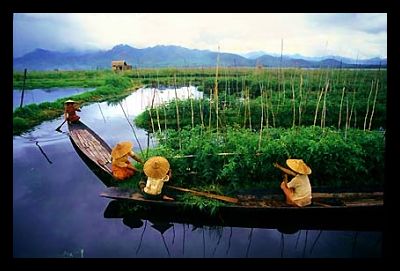
Floating gardens are rafts of aquatic weeds on which vegetables and other edible products can be grown. Practical Action, a UK-based development organization, is currently heading a program to introduce these floating gardens in the Gaibandha district of northern Bangladesh.
Bangladesh is home to some of the world’s most unstable rivers. Monsoon season has always left fields and land submerged for certain periods throughout the year, but climate change has intensified these seasonal floods. Often fields are submerged for longer than two months and, even when the waters recede, are left too water-logged to yield crops.
Floating gardens are a pragmatic agricultural alternative for the more than a million Bangladeshis affected annually by flooding. Much of the appeal of this method is the relative ease of constructing and cultivating a floating garden.
Steps to Make a Floating Garden:
1. Decide on an appropriate size for the floating garden. Generally, rafts are about 8m long and 2m wide and are 0.6m to 1m deep. The exact size depends on the amount of space and resources available.
2. Collect water hyacinth. This aquatic weed will serve as the base, or raft, for the floating garden. Water hyacinth is fairly abundant in Bangladesh and is free for collection.
3. Lay bamboo poles over the collected plants. The poles should be appropriate to the overall size of the raft.
4. Collect additional water hyacinth and place it on top of the bamboo layer to build the thickness. Weave the water hyacinth into a raft.
5. Once the plants have been woven and the general structure of the raft has been established, remove the bamboo poles.
6. Wait for 7 to 10 days and add more water hyacinth to the existing raft.
7. Add a mulch of soil, compost, and cow dung to cover the raft. This layer should total about 25cm deep. Usually, the compost is composed of azola and other easily accessible organic matter.
8. Pick an appropriate place for the raft. Floating gardens should not be placed in waters with tides or currents as the water movement damages the water hyacinth and risks the total disintegration of the raft.
9. Plant seeds. The most effective technique is to place a couple of seeds into a ball of compost and tema, an organic fertilizer. These balls are placed in a shaded, protected area while the seeds germinate. Once seedlings sprout, plant them on the raft.
10. Tend the floating garden as appropriate to the crops planted. In Bangladesh, the most common crops tend to be leafy vegetables, okra, gourds, eggplant, pumpkin, and onions. Animals like ducks and rodents might be attracted to the rafts. Fencing, even using improvised means like fishing nets, can effectively protect the gardens.
11. Harvest the crops. Rafts can be reused or, if no longer in a useable condition, can be used as compost on a new raft.
– Lauren Brown
Sources: Practical Action, FAO
Photo: Visiting Paradise
