Kenya’s National Hygiene Program Addresses Unemployment Amid COVID-19
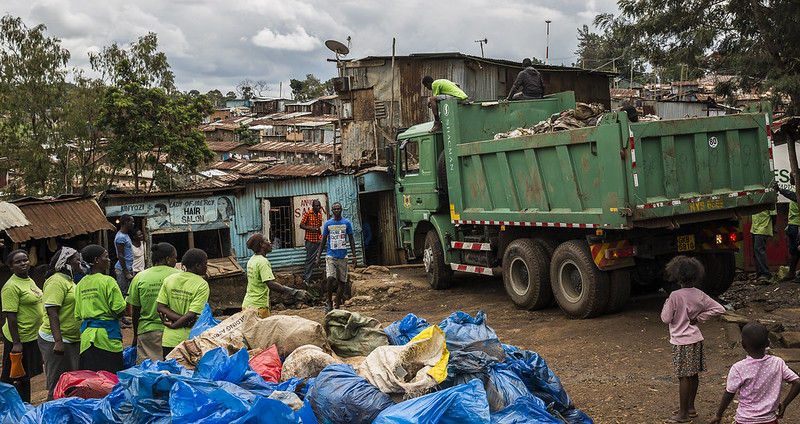
Kenya’s National Hygiene Program (otherwise known as Kazi Mtaani) aims to help the hundreds of thousands of Kenyans who lost jobs due to the COVID-19 pandemic. Implemented in April 2020, the program intends to support the individuals and households that are struggling to find work as a result of the restrictions and other issues that the pandemic created.
Impact of COVID-19 in Kenya
Kenya has a population of 51.39 million people and a rapidly growing urban population, which is increasing by about 4.3% every year. As Kenya urbanizes at a quick pace, formal housing in urban areas of the country struggles to keep up with high demand. About 60% of urban households in Kenya live in a “slum,” because informal housing remains the only option for most people.
COVID-19 hit these poor households in Kenya hard, causing over 300,000 Kenyans to lose their jobs. In Kibera, a county in Nairobi and one of the biggest slums in Africa, a survey found that 90% of low-income residents said that they had lost their family income due to COVID-19.
What Is the National Hygiene Program?
The National Hygiene Program is an extended public works project that emerged as a response to Kenya’s growing unemployed population. The goal of the program is to employ young individuals from informal settlements whose former employment has been disrupted by the pandemic. The program also aims to focus on projects that create cleaner, safer communities during the pandemic.
People must meet a few requirements to be accepted into this program. One requirement is that individuals have to be over 18 years old and under 35 years old because the program’s target audience is Kenyan youth. However, there is some leeway in communities that COVID-19 restrictions hit hardest and where youths are less willing to work. Aside from age, other requirements include the possession of a valid Identification Card, registration with Mpesa — a mobile money transferring service — and a verifiable telephone number.
Phase I
The first phase of the National Hygiene Program acted as a pilot, lasting from April 2020 through June 2020 and employing over 26,000 people. Eight counties that restrictions hit the hardest were the first to implement the program. These counties include Nairobi, Mombasa, Kiambu, Nakuru, Kisumu, Kilifi, Kwale and Mandera. In these areas, many people lost their daily wages, and businesses suffered because people could not afford to buy goods anymore.
Across these eight counties, the program targeted 29 settlements. The program paid workers about $1.03 per day, and they worked 22 days per month. In Phase I, the employees completed tasks like street cleaning, access path clearing, fumigation, disinfection, garbage collection, bush clearing and drainage cleaning.
Phase II
The second phase of the National Hygiene Program began in July 2020 and will run for six and a half months. The program has enrolled 270,000 workers and targets 1,200 informal settlements. Instead of employing workers for 22 days a month like in the first phase, the program’s 11-day rotation period will provide work for as many households as possible. Each worker has a daily wage of $0.78, and supervisors have a daily wage of $0.87.
In Phase II, workers will complete tasks like upgrading public sanitation facilities, creating or paving walkways, constructing community gardens and parks and repairing public buildings like offices and nursery schools.
As the National Hygiene Program continues, it hopes to cover all 47 counties in Kenya through later phases of the program. The program will allow Kenyans to escape unemployment while improving their communities, providing refuge from the destructive effects of COVID-19.
– Sophie Dan
Photo: Flickr
