Education Helps Eradicate Poverty in Chile
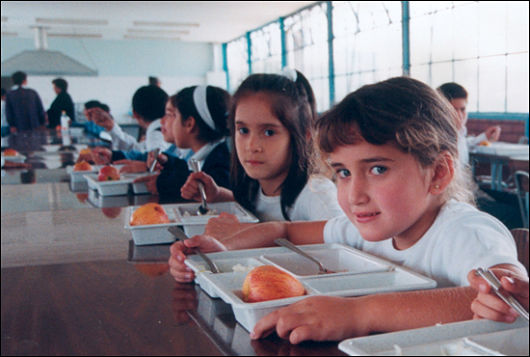
In recent times, some of the largest economic growth in South America has occurred in a small and notoriously narrow country, the Republic of Chile. A standard-bearer of free-market capitalism, Chile’s rapid expansion over the past 35 years has been staggering. According to Forbes, “poverty has fallen from 50 percent to 11 percent, per-capita income has increased from 4.000 dollars to almost 20.000 dollars and inflation was reduced from over 250 percent per year to less than 7 percent per year.” Often referred to as the “The Miracle of Chile,” this development seemed to lift the country out of economic and political chaos and into remarkable prosperity.
In 1973, Chile was in dire straits. Its annual rate of inflation had reached 150 percent and its economy was spiraling downward. On top of this, the country experienced the bloodiest coup of 20th century South America in which the military dictatorship of General Augusto Pinochet seized power from the Socialist president Salvador Allende. Over the course of just one month, over 3,000 Chileans lost their lives as military planes strafed and bombed the presidential palace. Ironically, this militaristic dictator became the source of the economic miracle.
General Pinochet promptly began to dismantle Allende’s socialist system and in its place instituted free-market economic policies. To enact these policies, Pinochet gathered together a collection of economists named the ‘The Chicago Group,’ as many members had studied at the University of Chicago. The group endorsed lower tax rates, the privatization of state companies, lower government spending and deregulation. But this growth came at a price to civil liberties and democratic values. In his 1980 constitution, Pinochet set the stage for Chile’s growth by prioritizing economic freedom at the cost of political oppression and social programs.
In 1990, Pinochet failed to retain his office after losing a public election and Chile steered back towards democracy. While his policies in the 1980s had brought the country out of financial failure and into economic prosperity, they left the poorest Chileans behind. Due to tax cuts and lackluster government spending, 45 percent of Chileans still lived in poverty. To the new Chilean government of the 1990s, the next big step was to confront poverty. Their solution was social spending.
Their plan was extraordinarily successful. Between the years of 1989 and 1997, the new Chilean government increased “health and education investments (mostly ignored under Pinochet) by 179.3 and 115 percent respectively,” according to a report from Brandeis University. This social spending helped to dramatically lower poverty; every percentage of growth Chile experienced between 1990 and 1996 counted 50 percent more to the reduction of poverty than under Pinochet’s regime. Ultimately, the poverty rate fell from 39 percent to 20 percent from 1990 to 2000. In comparison, poverty across South America only fell from 48 percent to 44 percent.
Of all social expenditures, education received the most attention and made the greatest impact. During the 1990s, spending on education grew at a rate of 10.6 percent annually and 274 percent cumulatively over the entire decade. The same Brandeis study mentioned above found that the increases in education spending were particularly effective in decreasing the severity of poverty in Chile.
However, Chile’s expansion, while exceptional, has not exactly been miraculous. According to the Brookings Institute, Chile has one of the highest rates of income inequality in the world. Unfortunately, Chile’s education system, particularly higher education, suffers from a similar form of stratification even though it has expanded by 33 percent in the past two decades. In terms of enrollment, 62 percent of Chileans from the upper 20th percentile in income attend institutions of higher education. By contrast, only 21 percent attend from the lower 20th percentile.
While Chile has developed rapidly, due in large part to social spending in education, it has left many of its poorest behind. With the current president Michelle Bachelet planning further tax increases to provide free education to all Chileans, it is possible that another miracle may be on the horizon.
– Andrew Logan
Sources: BBC, Bloomberg, Brandeis University, Brookings Institute, Forbes, IFPRI, MIT Poverty Action Lab, University of Hawaii
Photo: SnipView
