Students Slowly Returning to School in South Sudan
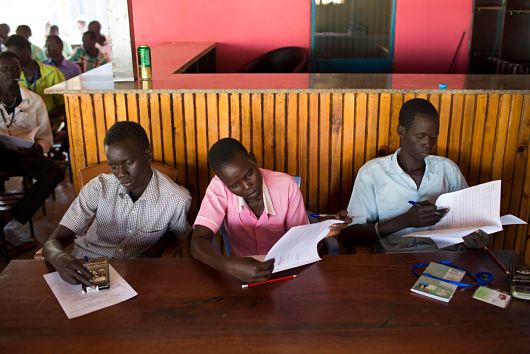
Decades of conflict have denied millions the right to education in South Sudan. Currently, about one million primary school-age children are not in school, and only 10% of those who enter actually complete a primary school education. Seventy percent of children ages 6 to 17 have never attended school at all, and gender and wealth gaps play a huge role in preventing some children from ever accessing education.
Even before violence broke out across the young nation in December 2013, schools were basic and ineffective. But now, the situation is even more dire—in the worst effected states of Jonglei, Upper Nile and Unity, 70% of the schools have closed. In some counties, no schools are currently open.
Five decades of civil war left a generation of adults who never had the opportunity to attend school in South Sudan. This is one major factor behind South Sudan’s adult literacy rate of 27%—one of the worst in the world. Only 2% of the adult population has completed primary school, meaning that many teachers in South Sudan never received a comprehensive education themselves. This has resulted in poor quality of instruction and a lack of official training in areas such as effective classroom management. Furthermore, schools themselves lacked important resources, from sturdy building materials, to textbooks.
Violence over the past year and a half has worsened the situation. Soldiers have re-purposed school buildings, and there is a deficit of teachers. Some teachers have been killed or forced to flee, while others have become involved in the conflict. 400,000 children have been forced out of school. Many have been displaced due to the violence, and when they fled for their safety, they had no choice but to put their education on hold.
In April 2006, the government’s “Go to School” initiative—one of the world’s most rapid reconstruction programs—enabled more than 1.6 million children to enroll in school, but the conflict has reversed some of this progress. Recent surveys have shown that citizens see education as a top priority, as it could be a path to peace for the country, and many groups are still working to improve the education system in South Sudan.
UNICEF began their Back to Learning Campaign in South Sudan in November 2014, and they have reached 121,000 children so far. They hope to reach 400,000 by December 2015. They are currently running two programs: the Integrated Education in Emergencies program for internally displaced students, and the Basic Education Package, which can be utilized by any child who is out of school.
South Sudan also has an Alternative Education Program, which initially began for soldiers but is now open to anyone. Many adults who never had access to education as children are utilizing the program. Furthermore, aid agencies are encouraging more women to attend school. South Sudan is still struggling in many areas, but with more students returning to school, education can become a means to further developing the nation.
– Jane Harkness
Sources: The Guardian, IRIN Africa, UNICEF 1, UNICEF 2
Photo: SBS
