The Varied Impacts of Violence on Girls’ Education in Syria
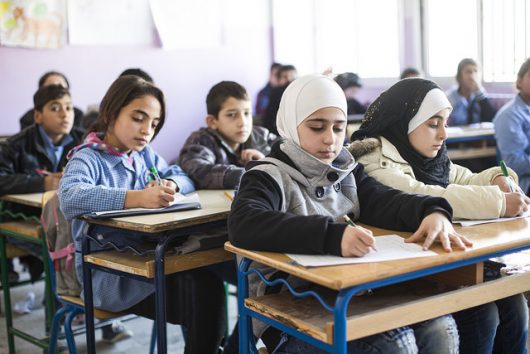
Prior to the civil war that has plagued Syria for six years, the Syrian government created a movement to end illiteracy by 1991. These efforts were fruitful, with enrollments stretching towards 100 percent.
At the onset of the conflict, however, education took a huge hit, with enrollments dropping drastically — 92 percent in 2004 to 61 percent by 2013 (for primary education). Just as one can see in non-government controlled eastern areas like Aleppo where as little as 6 percent of kids attend school, girls’ education in Syria has been affected most drastically.
Girls’ Education in Syria
This drop in schooling has created a consolidation of hardships. Not only are children subjected to violence and loss, but their acquisition of skills and knowledge falls behind the norm. In many areas, middle-school-aged kids are unable to complete first-grade math problems. This drag in skill alters the students’ self- esteem and perception, and leaves long-term effects.
The decline in scholastic enrollments can be directly and indirectly attributed to the Syrian conflict. School bombings and shootings have left facilities destitute, while simultaneously created an environment of fear surrounding schooling. In eastern provinces, 40 percent of schools have been shot at or bombed; as a result, more parents are inclined to keep their children out of school from fear of an attack.
Impact of Destruction
Buildings have been destroyed while others have been converted to emergency shelters, which are structural decisions that create a lack of space for education. In addition to an absence of physical space, the war has created a shortage of teachers — school staffing has fallen 22 percent due to death, emigration and fear of returning to work.
Many schools have suspended activity indefinitely to keep students out of harm’s way; others have been forced to move classrooms to secret locations, often underground, or have opted to replace glass windows with bulletproof plastic.
The violence has led to nearly 3 million of the 4.8 Syrian school-aged children to leave schools — about 2.2 million children within Syria and another half of a million Syrian child refugees.
Displaced and Uneducated
Syria has the most displaced persons out of any country in the world. Among refugee children, only 17 percent are in school. Language barriers coupled with political prejudice and financial inadequacy have made enrollment extremely difficult. While aid agencies have attempted to help refugee children, the well of information necessary for refugees to navigate a new and unfamiliar system remains largely untapped.
The war has been even more detrimental to girls’ education in Syria. In many cases, rape has been used as a weapon against young girls, inciting parental prejudice against female educational opportunities. Education is directly linked to opportunities and empowerment, particularly for young girls; interestingly, in areas of extreme conflict, girls are almost two and a half times more likely to be out of school, thus causing them to fall behind their male counterparts.
Save the Children
While many organizations — such as Save the Children and UNICEF — have intervened to help protect the children, in order to foster an environment conducive to learning, schools must be safeguarded against violence. Save the Children currently supports 53 schools in the northern regions of the nation through security, funding and promoting more sensitive teaching approaches. UNICEF advocates a similar approach by encouraging innovation for classrooms and supporting international responses to refugee children’s educational opportunities.
The protection of education and particularly girls’ education in Syria is necessary for economic recovery and social stabilization. Failure to address issues surrounding schools will only perpetuate the conflict and the issues left in its wake.
– Jessie Serody
Photo: Flickr
