10 Extremely Important Facts About Girls’ Education in Thailand
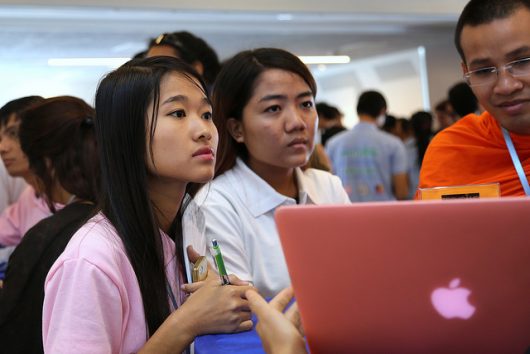
Thailand, a country located in Southeast Asia, has made great strides toward educating its population. From 1985 to 2005, the country had exceptional growth in its real income per capita and it is no secret that socioeconomic factors play a role in gender equality.
Because of economic growth and modernization, Thailand has continued to work toward a more equal society from its traditional male dominated society. Although the great advances in girls’ education must not go unnoticed, it is also worth noting there are still challenges in girls’ education. Here are 10 facts about girls’ education in Thailand that everyone should know.
10 Facts About Girls’ Education in Thailand
- Thailand’s Ministry of Education grants all children a twelve-year education, and under the 1999 Education Act, “all children, without discrimination” have a right “to a quality education.”
- Thailand has been one of four countries in Asia to successfully promote the right to girls’ education.
- Between the years 2005 to 2010, the primary school completion rate for girls in school was 89 percent while the completion rate for boys was 97 percent.
- Analyst Liza Romanow mentioned in the Global Majority E-journal that “educational opportunities for women in Thailand are improving. While there are still fewer girls than boys attending primary school, the gender gap has decreased considerably from slightly more than eight percent in 1971 to slightly less than two percent in 2009.”
- Challenges that continue to hinder girls’ education in Thailand include discrimination amongst marginalized groups, poverty, language and transportation to school.
- A further challenge is that some material taught in public schools perpetuates a cycle of gender inequality in all aspects of society. An example presented by the World Bank is a study that randomly selected 538 textbooks in schools and found that women represented in the textbooks were limited to playing small roles in society like marital duties rather than men who were represented as having superior positions in society.
- In 1977, Thailand’s agricultural sector improved, opening an increasing number of jobs for men. At the same time, cities began gaining more wealth. Because of the country’s economic growth and increasing amount of job opportunities in urban areas, women were able to actually have more opportunity in higher education than men and many were able to enter different industries in the city.
- Although women have more opportunities than men in higher education, there is still a disparity in earnings. While there has been significant progress since 1985 (when the average male was making 34 percent more than his female counterpart), in 2005, men still received nine percent more than women in the workplace.
- Thailand’s Ministry of Education has begun working with the U.N. to become the first country to adopt a U.N. policy toolkit to promote STEM education among Thai girls. Although 53 percent of science students in higher education are female, less than 24 percent of women study engineering, manufacturing and construction studies.
- In 1998, the Child-Friendly School (CFS) initiative was launched in order to promote education for all, and many of CFS’s activities are ongoing in Thailand today.
Every girl deserves the right to education. Thailand’s government has done tremendous work to promote girls’ education in the country but recognizes that it still has work to do. With combined efforts between the Thai government and international organizations, Thailand can continue to support and improve the well-being of girls’ education.
– Emma Martin
Photo: Flickr
