CSIS and Kaiser Family Foundation Discuss Financing for HIV/AIDS
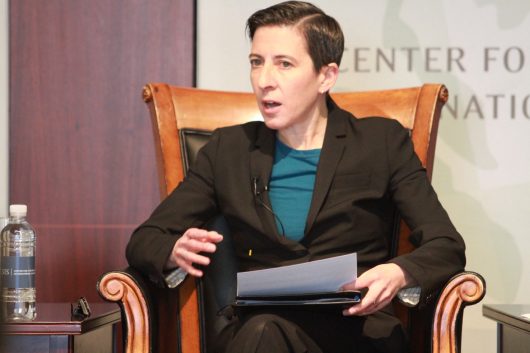
On April 18, 2018, the Center for Strategic and International Studies (CSIS) partnered with the Kaiser Family Foundation to host a discussion of the current state and future of financing for HIV/AIDS. The Borgen Project was invited to attend this critical summit and hear from the leading voices in this space.
About 36.7 million people worldwide were diagnosed with HIV/AIDS by the end of 2016; one million of those cases resulted in fatality. A disease that still affects so many requires adequate funding for care, treatment and prevention.
The fight against AIDS began in 1981 when the Centers for Disease Control and Prevention (CDC) published a Morbidity and Mortality Weekly Report which detailed one of the first cases of the disease. From there, the CDC began to work on discovering risk factors.
Between 1996 and 2000, spending on HIV/AIDS from major donor countries increased from $248.45 million to $749.37 million. According to Christopher J.L. Murray, one of the panelists and a professor at the University of Washington, “If you cumulate total spend since 2000, the world has spent just around half a trillion dollars on HIV/AIDS.”
The amount of financing for HIV/AIDS continuously increased through the years up until 2011. Murray pointed out current spending trends using a graph. “From basically 2011, with the exception of 2012, we have been flat,” meaning that total spending from donor assistance channels, such as the WHO and World Bank, has not increased since 2011. Though some individual channels may have increased financing for treatment and prevention, others have decreased spending, making total spending fairly consistent in recent years.
Another concern for financing for HIV/AIDS is the limited spending coming from countries with the highest numbers of affected people. The majority of financing is coming from the upper and upper-middle income countries. J. Stephen Morrison, the Senior Vice President and Director of the Global Health Policy Center, pointed out some of the most striking realizations that have come from new data on HIV/AIDS.
“It also begins to show us a way in which there has been an erosion of the financial and political commitment dedicated to those low-income countries with the greatest burden and the greatest prevalence,” Morrison noted. “The most dramatic point was in saying that since 2012, 2013, a 23.7 percent decline in the levels of donor assistance into those countries from just over 12 billion to 9.1 billion dedicated to HIV.”
The stagnant spending is a severe problem considering the rate of population growth. Mark Dybul, one of the panelists and a professor at Georgetown University, pointed out the hypothetical: “You double the population, you’re going to double the size of the infection rate.” A Business Insider estimation claims that more than half of the population growth that will occur between now and 2050 is going to occur in Africa. As Africa is also the site of the highest number of HIV/AIDS cases, this means that the rate of those infected with HIV/AIDS will likely increase significantly.
The future of financing for HIV/AIDS is looking challenging to Dybul given the difficulties in raising funds. “The reality is, there is no argument that’s going to get an increase in donor funding for HIV. We are at the highwater mark, we are not going up.” Dybul suggested that, instead, change will come through smarter investing, including focusing on prevention first, and treatment second.
Additionally, Dybul suggested that some change is needed in how we talk about the epidemic. As he pointed out “Young people in Africa don’t think about HIV anymore, they think about other things.” In this way, raising awareness may be crucial in fighting HIV/AIDS.
Moving forward with financing for HIV/AIDS will be a challenge considering stagnant spending across the board, little spending from low-income countries, and the drastic population growth expected in Africa in the coming years. But with changes in how organizations and governments invest and heightened awareness of the epidemic, it is possible to win the war against HIV/AIDS.
– Olivia Booth
Photo: CSIS
