Banana Fiber in Uganda: A Sustainable Solution
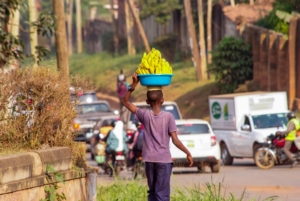 The East African Highland banana, a staple food crop, is cultivated by roughly 75% of Ugandan farmers, making it a cornerstone of both agriculture and daily life. Uganda is also the top banana consumer per capita globally and Africa’s largest producer of the crop. However, this agricultural abundance has a downside: every banana harvest leaves behind heaps of pseudostems, an organic waste that typically rots in the field.
Now, innovators are reimagining that waste as the basis of a growing industry that produces biodegradable textiles, boosts rural employment and positions Uganda to meet global demand for sustainable materials.
What Is Banana Fiber and Why Now?
Banana fiber is a strong, biodegradable material extracted from the pseudostem of the banana plant. Previously discarded after harvest, these stems are now being repurposed into textiles, rope, hair extensions and even vegan leather. Compared to cotton, banana fiber requires less water and fewer chemicals and decomposes naturally. This makes it a timely alternative in the global push for sustainable materials.
This transformation was initially spearheaded by the Banana Textiles in East Africa (Banatex-EA) project at Busitema University, with support from partners like TEXFAD, a local startup. The project’s goal is to commercialize banana fibers as an alternative to cotton. According to project lead Edwin Kamalha, banana fibers share several desirable properties with cotton but with a lighter environmental footprint.
Yet regulatory and technological barriers remain. Uganda has yet to pass a biotechnology bill that would allow for genetic improvements to banana varieties better suited for fiber production. Production costs are high and large-scale mechanization is still limited, which has so far restricted the market’s ability to scale.
An Industry Takes Root: Rural Jobs and Local Impact
Banana cultivation has expanded steadily in Uganda, especially in the southwest, boosting regional incomes. Despite these gains, several smallholder farmers live below the poverty line. In response to this economic disparity, attention is now turning to banana fiber in Uganda. Its value chain is labor-intensive by nature, involving cultivation, stem harvesting, fiber extraction, spinning, weaving and final product design. This structure creates a spectrum of skilled and semi-skilled jobs, particularly in rural areas where unemployment can reach nearly 10%.
TEXFAD is currently employing both full-time and part-time workers across the fiber-to-product pipeline. The Small and Medium-sized Enterprise (SME) sources stem from local farmers, train artisans in fiber processing and produce items like rugs, table runners and biodegradable hair extensions. More than 50% of TEXFAD’s hires are women, many of whom previously worked informally or were unemployed.
Similarly, the Banatex-EA initiative has created at least 30 full-time jobs, with more anticipated as the project scales. Three recent graduates from Busitema University have been recruited into technical roles, helping bridge academia and industry.
A Sustainable Market on the Rise
Globally, the demand for sustainable and circular materials is surging. From fashion brands seeking biodegradable textiles to eco-packaging solutions and plant-based alternatives to leather, banana fiber aligns well with these market trends. With its abundant raw materials and growing technical know-how, Uganda is well-positioned to be a leader in this space.
Still, structural challenges such as regulatory gaps and a lack of industrial-scale fiber processors must be addressed to reach export viability. As innovation continues and pilot programs like Banatex-EA demonstrate success, Uganda could unlock new export revenues while reducing rural poverty.
– Sriya Regulapati
Sriya is based in Vancouver, Canada and focuses on Business and Good News for The Borgen Project.
Photo: Pexels
