Artemia Farming Offers New Livelihoods to Bangladesh’s Salt Farmers
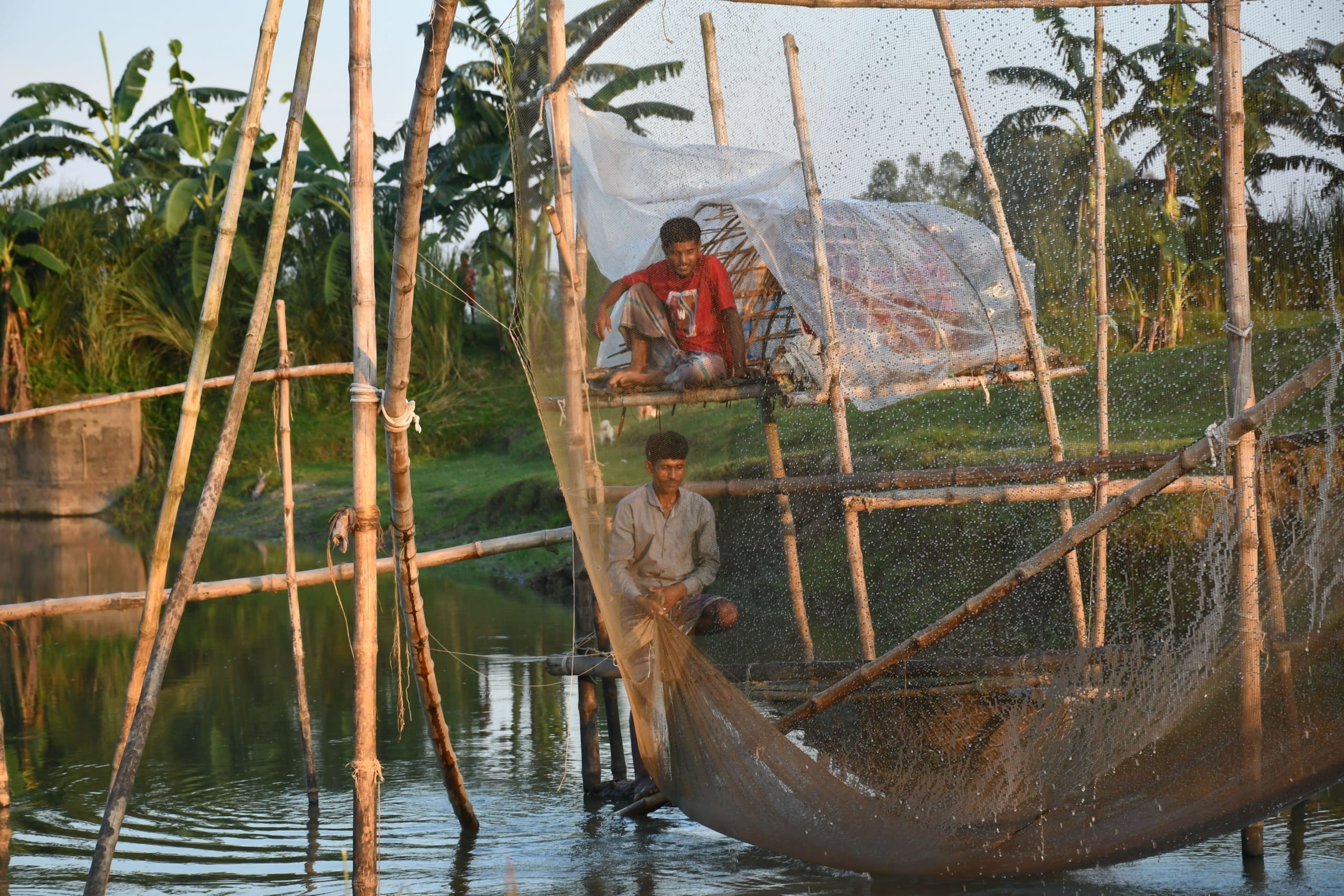
The Food and Agriculture Organization (FAO) estimates that 50,000 small-scale farmers in Bangladesh’s coastal Cox’s Bazar area produce almost 95% of the nation’s crude salt. Yet many households face erratic income. Farmers produce salt during the dry season and cultivate fish and shrimp during rainy months. Storms, flooding and unpredictable rainfall can disrupt production, while low aquaculture productivity further reduces revenue. The WorldFish-led Artemia4Bangladesh initiative introduced Artemia farming as an additional income source alongside salt production.
How Artemia Farming Works
Brine shrimp, or Artemia, are tiny crustaceans that thrive in extremely salty water. Their dormant eggs, known as cysts, can be hatched to produce live feed for fish and shrimp larvae. Through the EU-funded Artemia4Bangladesh project, WorldFish integrated Artemia cultivation with seasonal aquaculture operations in Cox’s Bazar’s salt-farming systems. Project technical lead Dr. Muhammad Meezanur Rahman described the initiative’s goal of enhancing farmers’ livelihoods through integrated salt, Artemia and aquaculture production in a 2021 report published in The Business Standard. Aquaculture producers can purchase harvested Artemia products from farmers, opening up another potential revenue stream.
What the Impact Assessment Reveals
The EU-funded Artemia4Bangladesh project commissioned an impact evaluation in 2024 to examine changes in farming methods and livelihoods. Using surveys, interviews and focus groups, Exemplary Consulting gathered data from 401 respondents, including 356 farmers from demonstration, trained and nonintervention groups.
The assessment reported promising returns from Artemia cultivation. The 36 demonstration farmers reported profits of 218,295 Bangladeshi taka (BDT) per hectare (approximately $1,762), while the five trained farmers reported profits of 259,945 BDT per hectare (approximately $2,099). These USD equivalents use Bangladesh Bank’s weighted-average exchange rate of $1 = BDT 123.87 on Oct. 27, 2026.
Nevertheless, no nonintervention farmers reported growing Artemia, and the trained-farmer figures are based on a survey of only five farmers. As a result, while the assessment indicates economic potential, it cannot directly compare all three groups or separate Artemia’s impact from other project support and farm-specific differences. Its limited assessment period also made it more difficult to evaluate longer-term adoption.
From Additional Income to Poverty Reduction
Artemia’s potential poverty-reduction benefit lies in diversifying revenue beyond seasonal salt production. According to an FAO feature, 3,000 farmers who adopted integrated farming technologies reported annual income increases of at least 40%. This figure concerns integrated farming technologies, not Artemia alone. Training and access to local hatcheries helped farmers sell Artemia biomass and eggs. Because the approach combines salt production with aquaculture across seasons, it can help farmers make use of existing ponds and infrastructure rather than abandon salt farming.
FAO also reported that 88% of demonstration farmers and 72% of trained farmers were enabled to open bank savings accounts. These results reflect the wider project and cannot be attributed to Artemia alone. Although the evidence does not establish increases in spending on food, education or health care, supplemental income could help households cover basic expenses and withstand disruptions to salt production.
Farmers’ Experiences and Published Expert Perspectives
Cox’s Bazar farmer Nurul Absar gained another source of income alongside salt production. “I had a very limited scope of earning apart from salt production. Now, the earnings received from Artemia, and aquaculture have increased the income of my family,” he explained in a WorldFish-published account. Farmers could sell Artemia to nearby hatcheries and other aquaculture businesses.
Dr. Muhammad Meezanur Rahman, the project’s technical lead, stated: “We were able to demonstrate that Artemia culture is technically feasible, economically profitable and socially acceptable in Bangladesh.”
Project partner Professor Patrick Sorgeloos of Ghent University highlighted Artemia’s potential to help farmers manage weather-related disruptions. “Your salt farming is compromised, but you still have Artemia to fall back on,” he explained in an FAO feature. The impact assessment provides broader evidence of profitability, while Absar’s experience illustrates potential household benefits. One farmer’s testimony, however, cannot establish how consistently benefits extend across participating households.
Artemia Farming: Barriers and Long-Term Sustainability
Despite encouraging results, long-term sustainability depends on technical expertise, affordable production and stable markets. According to the FAO case study, 65% of training participants applied what they had learned across the project’s aquaculture interventions, which included more than Artemia cultivation alone. This demonstrates that training does not automatically translate into adoption.
Farmers also need processing facilities, affordable inputs and suitable ponds. Professor Patrick Sorgeloos of Ghent University emphasized the need for locally sourced facilities to process and preserve Artemia cysts and biomass during a 2021 training event covered by The Business Standard. Without reliable processing and preservation, farmers may struggle to maintain product quality and meet buyers’ needs. Cyclones, flooding, unpredictable rainfall, unreliable buyers and limited technical capacity may also undermine returns.
The Artemia4Bangladesh project ran from March 2020 to October 2024, according to FAO. Available evidence does not establish how many original participants continued producing and marketing Artemia independently afterward. Affordable technology, ongoing technical assistance and stable markets are necessary for wider benefits.
A Promising but Conditional Pathway to Poverty Reduction
Artemia offers Cox’s Bazar salt farmers a way to diversify income without abandoning their existing farming methods. Farmer accounts and project findings suggest potential household benefits, but promising returns do not guarantee long-term poverty reduction. Benefits depend on sustained production, affordable facilities and reliable buyers beyond project support. Technology can help alleviate poverty when it addresses local needs, but lasting change requires farmers to continue using it and earning a steady living.
– Zeba Vagh
Zeba is based in Melbourne, Victoria, Australia and focuses on Technology and Solutions for The Borgen Project.
Photo: Pexels
