Giant HeroRATs and Landmine Clearance in Cambodia
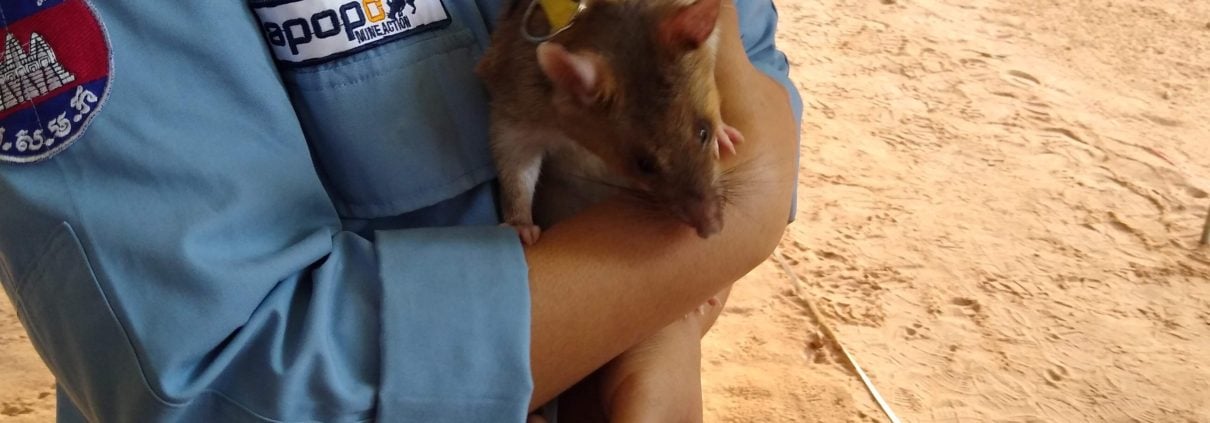 Decades after conflict, landmines and unexploded ordnance continue to affect rural communities in Cambodia. These hidden explosives make farmland, roads and forests dangerous, limiting where families can live, work and travel. For communities facing poverty, landmine contamination can prevent the use of land for agriculture, housing, schools and infrastructure.
Despite decades of clearance efforts, Cambodia still had an estimated 1,700 square kilometers of confirmed or suspected hazardous land remaining at the beginning of 2025, according to the Khmer Times. Much of this land is located in rural provinces where agriculture is an important source of income.
One of the most unusual tools supporting landmine clearance in Cambodia is the African giant pouched rat. APOPO, a nonprofit organization that uses detection animals to locate explosives, trains these rats, known as HeroRATs. Their work has become especially relevant as Cambodia moves toward a newly updated mine-free deadline of Dec. 31, 2030.
Cambodia’s Updated Mine-Free Timeline
Cambodia had previously worked toward a Dec. 31, 2025, mine-clearance deadline under Article 5 of the Anti-Personnel Mine Ban Convention. However, the country submitted a new extension request in April 2025 and a revised request in October 2025. The Twenty-Second Meeting of the States Parties granted the request, setting Cambodia’s new deadline at Dec. 31, 2030.
The updated timeline gives Cambodia five more years to complete its mine-clearance obligations. It also shows why efficient and innovative tools remain important. According to Mine Action Review, Cambodia released 130 square kilometers of mined area through survey and clearance in 2024, though this was less than its target. Escalating tensions with Thailand halted a border survey that began in November 2024, ending the effort in June 2025.
How HeroRATs Detect Landmines
APOPO trains HeroRATs to identify the scent of trinitrotoluene (TNT), a chemical used in many landmines and explosive remnants of war. Because they are light enough to avoid setting off most mines, the rats can move across suspected hazardous areas and signal handlers when they detect explosives, making them more efficient and safer than other methods. Human deminers then mark, excavate and safely destroy the mines or unexploded ordnance.
APOPO’s Cambodia program has expanded beyond its early years. The organization says its current team includes more than 100 people; it recruited and trained most of them from mine-affected areas. APOPO also reports that more than 60 animals are working across four Cambodian provinces: Siem Reap, Preah Vihear, Battambang and Ratanakiri.
APOPO’s Recent Milestones in Cambodia
The organization began demining operations in Cambodia in January 2014 and introduced Mine Detection Rats in 2015. Since then, the program has grown into a long-term part of Cambodia’s mine action work. In 2024, APOPO marked 10 years of mine action in Cambodia. The organization reported that its teams had helped locate and destroy 2,669 anti-personnel mines, 18 anti-tank mines, 2,441 unexploded ordnance items and 946 cluster munitions. APOPO also reported that its work had directly affected more than 50,000 Cambodians by returning land for farming, housing and infrastructure.
Recent deployments show that the HeroRAT program is still active. In July 2024, APOPO sent 20 newly trained HeroRATs to Cambodia. It expected 14 to join mine detection work and assigned six to its Visitor Center in Siem Reap for demonstrations.
APOPO also reported another new deployment in 2025, when 24 new Mine Detection Rats arrived in Cambodia. It assigned 20 of the rats to live mine clearance operations and sent four to the Visitor Center in Siem Reap. These new arrivals show that APOPO continues to invest in landmine clearance in Cambodia as the country works toward its updated 2030 deadline.
Land Clearance and Poverty Reduction
Mine clearance closely connects to poverty reduction because land is one of the most important resources for rural communities. When mines contaminate land, families may be unable to farm safely, expand housing or build infrastructure. Removing landmines can allow people to return to fields, grow crops, travel more safely and develop community spaces.
Cambodia has already made major progress. According to Agence Kampuchea Presse, citing the Cambodian Mine Action and Victim Assistance Authority, Cambodia cleared 3,439 square kilometers of land between 1992 and July 2025 for agricultural, infrastructure and community use. This included land for homes, villages, schools and health centers, benefiting more than 10 million people. From January to July 2025 alone, Cambodia cleared 141 square kilometers of mine-contaminated land and destroyed 6,405 anti-personnel mines, 125 anti-tank mines and 25,845 explosive remnants of war.
For rural families, this progress can mean more than safety. For example, Cambodia has returned land cleared of mines for farming, allowing families to grow crops again instead of leaving fields unused because of safety concerns. The government has also returned cleared land for housing, schools, health centers and agriculture, allowing communities to rebuild while expanding opportunities for food production and local economic development. According to the Cambodian Mine Action and Victim Assistance Authority, Cambodia returned 81% of land cleared between 1992 and 2024 to agriculture, while authorities used additional land for infrastructure, housing, schools and health centers, benefiting more than 10 million people.
Looking Toward 2030
Cambodia’s new 2030 deadline shows that the country’s landmine challenge is not over. Remaining contaminated areas may be difficult to reach, costly to clear or complicated by border tensions. However, APOPO’s recent milestones show that HeroRATs continue to support landmine clearance in Cambodia. By helping identify explosives, these animals help return dangerous land to productive use, turning contaminated areas into farmland, roads, schools, homes and opportunities for safer livelihoods.
– Ben Jordan
Ben is based in Saint Louis, MO, USA and focuses on Good News and Technology for The Borgen Project.
Photo: Wikimedia Commons
