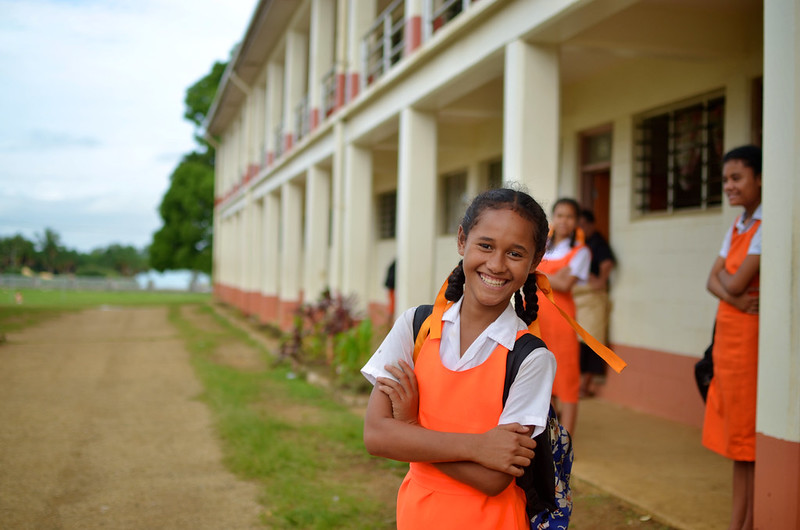
Tonga, a Pacific island kingdom with roughly 109,000 residents, has long viewed education as critical to its development. The country’s formal education roots trace back to 1826 when Wesleyan missionaries introduced the system in Tonga, the national language, with English taught alongside. Today, adult literacy stands exceptionally high, well above 98%, reflecting a deep-rooted cultural commitment to learning.
8 Facts about Education in Tonga
- Tonga maintains a 6‑3‑3 system: six years of primary education starting around age 6, followed by three years each of junior and senior secondary, totaling 12 years of compulsory and free schooling in public institutions. Most students enroll in public schools, with mission schools serving about 83% of primary and 90% of secondary education.
- Enrollment remains strong, and almost 98.5% of school-age children attend school, though some remote or economically disadvantaged children are locked outside the system.
- Pre-primary education, once limited in reach, has expanded significantly in recent years. As of 2020, net enrollment rates in Tonga hit 94.6% among 4 and 5-year-olds. This growth is partly due to new community-based centers built in partnership with NGOs and faith-based organizations, helping to prepare more children
- Tonga has approximately 95 primary and 22 high schools, along with around 20 tertiary institutions, including the newly established Tonga National University (TNU), which opened in January 2023 from the merger of several government institutes.
- Public investment in education is robust: as of 2021, education comprised nearly 4.9% of GDP and 10.1% of total government expenditure. Despite strong literacy, student learning outcomes point to areas needing improvement. In the 2021 Pacific Islands Literacy and Numeracy Assessment, only 38% of boys and 56% of girls in Year 4 achieved the minimum reading proficiency. Furthermore, the national secondary math exam pass rate was just 17%.
- Tonga continues to suffer from low teacher supply and capacity. Many schools operate with high student-teacher ratios, especially in outer islands. Data on secondary teacher qualifications is dated, but the most up-to-date figure available is that only 58.7% of secondary teachers were trained as of 2014. To tackle this, the government is investing in in-service training programs and certification pathways to professionalize the teaching workforce.
- To bolster quality and resilience, Tonga launched the Tonga Safe and Resilient Schools Project: a World Bank–supported initiative expanding access to disaster-resistant classrooms, better sanitation, and staff housing. A $21 million additional financing will extend benefits to about 8,000 students.
- Simultaneously, the Global Partnership for Education (GPE) approved a System Transformation Grant in July 2024 ($2.5 million plus emergency funds in 2022), which supports curriculum reform, classroom libraries, reading boosters, and home-based learning. This is particularly beneficial for boys, children with disabilities, and students from low-income families. Additionally, development partners, such as Australia and New Zealand, continue to support literacy and numeracy programs (e.g. TESA) as well as broader technical and vocational education.
Tonga’s educational system is characterized by universal access, strong literacy, and expanding tertiary pathways, including the Tonga National University. Yet, early learning outcomes and secondary-level mastery remain weak, while adult learning participation is modest. New investments in early literacy, upgraded infrastructure, and curriculum reform (backed by international partners) are crucial for ensuring that Tonga’s young generation is not only educated but also prepared to thrive in the real world.
– Jeff Zhou
Photo: Flickr
