A Shift in Girls’ Education in Afghanistan
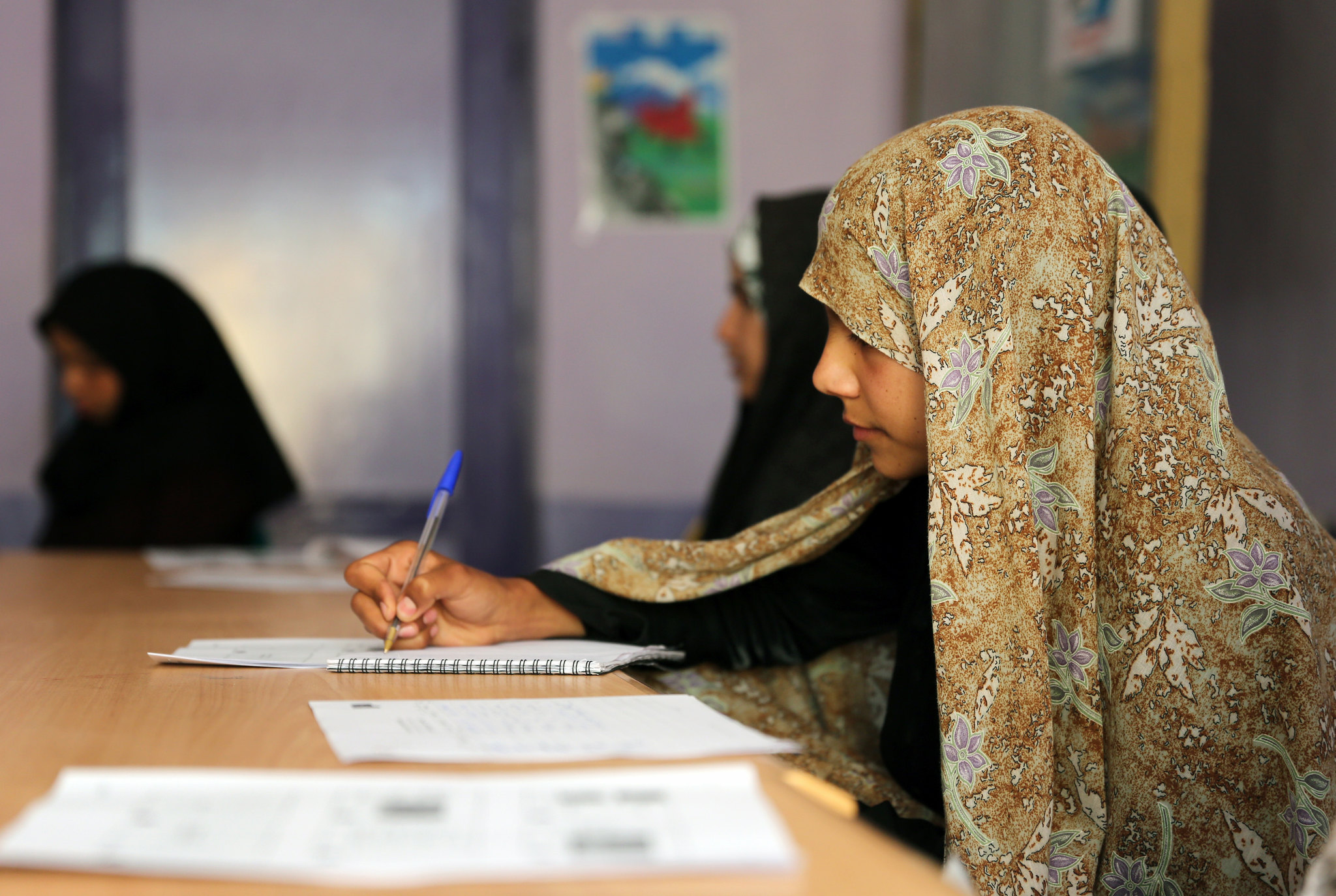 Political and economic instability have been facts of life in Afghanistan for decades. However, one of the few institutions that has made a significant recovery is the education system. There are still twice as many boys in school as there are girls. However, since 2008, the overall number of girls in school has gone up significantly.
Changing attitudes about girls’ education in Afghanistan have bolstered female enrollment rates. This shift has, in turn, increased support for public education in general and foreign aid—particularly from the U.S. Agency for International Development. USAID statistics offer some encouraging numbers to support this:
- Of 9 million children enrolled in schools, 3.5 million are girls,
- USAID has distributed over 170 million textbooks, and
- USAID has helped train 280,000 new teachers.
The Rustam School
One promising example of this shift forward is the Rustam School, located in the Yakawlang district. The Rustam School possesses a small student body of only a few hundred. Nevertheless, 92 percent of its graduating class moved onto Afghanistan’s public universities in 2017.
Inverting the country’s enrollment statistics, two-thirds of the Rustam School’s students are girls. To note, the Taliban outlawed girls’ education in Afghanistan and pushed many boys into Islamic studies, rather than popular STEM courses. However, students, particularly girls, apply themselves rigorously to their education. They go so far as to learn the Windows operating systems without the aid of a computer.
The Fight for Education
Unlike in the United States, where public K-12 education is universal, the fight for education in Afghanistan has a checkered past. As far back as the 1970s, mujaheddin resistance fighters (rebelling against the USSR’s attempted occupation of Afghanistan) were killing government-paid teachers and closing down their schools.
With over half of the country’s 36 million citizens under the age of 18, the investment and safeguarding of education are more critical than ever. In recognition of this fact, USAID, the Pentagon and the State Department have invested $759 million in primary and secondary education over the last 17 years. These investments have fostered the changing attitudes of both local politicians and regional power-brokers—with the constant exception of the Taliban.
Though the expansion and protection of girls’ education in Afghanistan have had much progress, there is still room for improvement. The majority of Afghan girls are not enrolled in public school. This is explained by two main factors. First, most Afghan girls still marry at a very young age (for a variety of sociocultural factors). Subsequently, this causes a lack of female teachers and all-girls’ schools. Second, Afghanistan faces logistical difficulty when it comes to extending education to rural areas. Long walks to school sometimes have significant geographical barriers along the way that physically prevent students from attending. Also, many rural families are subsistence farmers; it is difficult for students to go to school if they have animals or crops to look after. However, the Rustam School proves that though providing education to rural Afghan children may be difficult, it is not impossible.
The Future of Education
Despite the recent progress and development of education in Afghanistan since the early 2000s, significant hurdles exist for girls’ education. The country’s education system must still be further advanced. However, a local initiative can make do with minimal resources and reach out to rural areas—like the Rustam School. Most importantly, despite its shortcomings, Afghanistan’s primary and secondary education systems offer success stories of what foreign aid can accomplish, especially if maintained over long periods of time.
– Rob Sprankle
Photo: Flickr
