6 Facts About Healthcare in Iraq
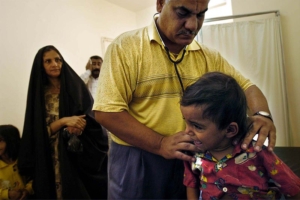 The Republic of Iraq is a country that previously possessed one of the most comprehensive healthcare systems in the Middle East. However, decades of war, economic crises and terror groups such as the Islamic State have stripped this once prosperous network. Although several recent initiatives have focused on rebuilding medical infrastructure, many new challenges lie ahead for the Iraqi people. Here are six relevant facts concerning the state of healthcare in Iraq.
6 Facts About Healthcare in Iraq
-
Iraq’s healthcare system was once one of the most advanced in the region. Due to a mid-20th century oil boom, Iraq enjoyed a period of relative stability and increased development. By the 1970s, the Iraqi healthcare system was one of the most strongest and centralized institutions in the region. Many hospitals and primary care clinics offered free services to Iraqi citizens while medical professionals of the country trained at elite institutions abroad. However, the Iran-Iraq War, which consumed the region for the majority of the 1980s, prompted a steady decline in availability and quality of healthcare in Iraq. Due to mounting military casualties, damage to infrastructure and increasing debt, civilian access to quality medical care began to decrease.
-
Healthcare personnel have been in increasingly high demand in Iraq. In recent decades, violence caused by invasions and terrorism has taken a great toll on the number of practicing medical professionals in the country. Due to the political chaos after the fall of Saddam Hussein, an estimated 15,000 Iraqi doctors left the country for richer and more stable countries. The Iraqi government now offers returning doctors easy access to employment and higher salaries. In spite of this, returners are few and far between. Hope for the Iraqi healthcare system primarily lies in the younger generation of student doctors. However, student doctors primarily seek training abroad rather than permanent employment.
-
Many of the hospitals in Iraq are understaffed and in various states of disrepair. In the 1990s, a 90% budget cut led to the rapid degradation of equipment, buildings and the training of medical professionals. While no further budget cuts followed, the decades of war that followed did little to help. Many of the buildings were further looted. By the mid-2000s, around 33% of primary care clinics and 12% of hospitals were severely damaged. Around half of the primary care facilities in the country are currently not staffed by doctors. The majority of these buildings have no access to running water, worn-out machines and shortages of medicine along with other basic medical supplies. The doctors present are often overspecialized and in need of more thorough training.
-
Rebuilding portions of the Iraqi healthcare system has proven to be a daunting prospect. Many factors played into the decrease in Iraqi healthcare quality. However, the 2003 U.S.-led invasion arguably had the greatest impact on current reconstruction efforts. The widespread looting, destruction of facilities and flight of numerous medical professionals negatively impacted healthcare in Iraq on a great scale. By comparison, the autonomous Kurdistan region, which has been relatively stable from 2003, has had far fewer issues in the development of medical facilities. In Iraqi Kurdistan, there was a 4.3 primary care center per 100,000 population increase from the 2012 national average of 7.4. By comparison, the rest of the country averaged around a 1.4 primary care center increase. Rebuilding the healthcare system should be a significant priority of the Iraqi government due to the lack of foreign investment.
-
Iraq’s healthcare system has failed to control the COVID-19 outbreak due to a variety of factors. Iraq’s healthcare infrastructure has been in a difficult situation for the last several decades. To make matters worse, the COVID-19 outbreak has pressed it to its limit. There has been premature opening and easing of lockdown restrictions. As a result, cases of COVID-19 have skyrocketed in the country over recent weeks while top Iraqi medical professionals have urgently advised the opposite course of action. With 94,693 cases as of July 21, the situation in the country grows increasingly dire by the day.
-
The nongovernmental organization Doctors Without Borders is concentrating efforts on improving the quality of healthcare in Iraq. The group has promoted initiatives with around 1,500 staff as of 2018. Support has shifted to the establishment of field hospitals providing medical support for conflict-related injuries. Additionally, the aforementioned hospitals provide support for younger children, assisting with up to 1,000 deliveries a month. Future initiatives include the provision of tuberculosis medication and programs aiding with mental healthcare.
Conclusively, there are many challenges lying ahead for Iraqis in the domain of medical care. Reconstruction efforts are far from nonexistent. However, decades of conflict and instability have introduced new factors potentially interrupting the progress of rebuilding.
– Samuel Levine
Photo: Wikimedia Commons
