10 Facts About UN Secretary-General Antonio Guterres
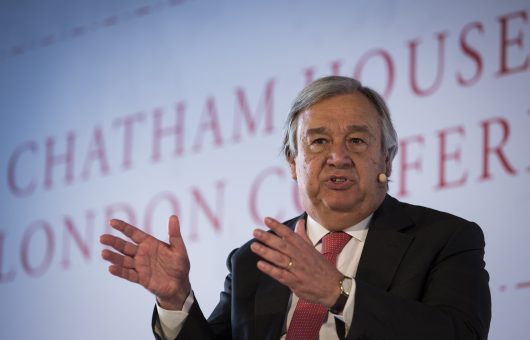
Antonio Guterres of Portugal became Secretary-General of the U.N. on Jan. 1, 2017, following Ban Ki-moon.
If the name Antonio Guterres does not sound familiar, then these ten facts will be sure to provide a thorough education about the man who hopes to change the world we live in during his time serving as Secretary-General.
- Guterres grew up during an age of change in Portugal. Antonio Guterres’ childhood was mostly spent under the military dictatorship of António de Oliveira Salazar. After the 1974 revolution, Guterres identified as a Portuguese socialist, witnessing change in the country’s government.
- According to the Guardian, Antonio Guterres was known as a “fearsome orator” during his time in Parliament, known to destroy his opponents’ arguments with clear and logical facts. Guterres later said his time in Parliament helped prepare him for the large speaking role that comes with being Secretary-General of the U.N.
- He is a family man. During his time as Prime Minister of Portugal, Guterres’ wife Luísa Guimarães e Melo became severely ill and had to receive treatment at a hospital in London. Despite working long hours in Portugal during the week, Guterres would fly to London on the weekends to spend time with his wife before returning bright and early Monday morning. On top of this enormous amount of stress, Guterres had two young children to look after and was known to spend a lot of time with them whenever he was home.
- He cared too much about his country to let it fall into a “political swamp.” After his party showed weakness and was in danger of a serious restructuring, Guterres resigned his position as Prime Minister, citing that even “politics has its limits.”
- He left national politics to focus on the world. After his resignation, Guterres spent time reflecting on what he wanted to do next. He knew that he “never wanted to return to national politics,” and eventually decided on making a difference in the world. He began doing so as the U.N. High Commissioner for Refugees (UNHCR).
- He is a champion for “people on the move.” Antonio Guterres made tremendous strides for refugees during his time as UNHCR, particularly in widening the scope of who the U.N. would help when it came to migrants and displaced people.
- His mission is social justice, equality and peace. In an opinion piece for Newsweek, Guterres writes, “As secretary-general of the U.N., I have called for a surge in diplomacy for peace and appealed for 2017 to be a year for peace. The U.N. was born from war. Today, we must be here for peace.” He seeks to achieve his goals on a global scale, and believes he can do so in the five years he has as Secretary-General.
- He is an avid reader. President of Refugees International Dr. Michel Gabaudan says that whenever Antonio Guterres visited Washington D.C., he would check out the bookstore Politics & Prose, spending whatever time he had searching for English books that were not easy to find in Europe.
- He supports women’s equality and wants to see a better representation of women in the U.N. “Generally, no one likes to lose positions they have long held,” Antonio Guterres shared on the floor of the U.N., “but the reality of gender parity is that many more women will be in positions that today are occupied by men. But that’s a good thing.”
- He is committed to people. Antonio Guterres’ policies as Prime Minister of Portugal and at UNHCR have been formed with people in mind, and he doesn’t intend to change this anytime soon. The U.N. must focus on “people rather than bureaucracy,” he writes in his Newsweek opinion article.
The next five years look bright under Antonio Guterres’ guidance. Hopefully, the U.N. will adapt to the world we live in today and ensure the future is peaceful and equal, just as the new Secretary-General is working hard to do.
– Jacqueline Nicole Artz
Photo: Flickr
