Higher Education in Sierra Leone
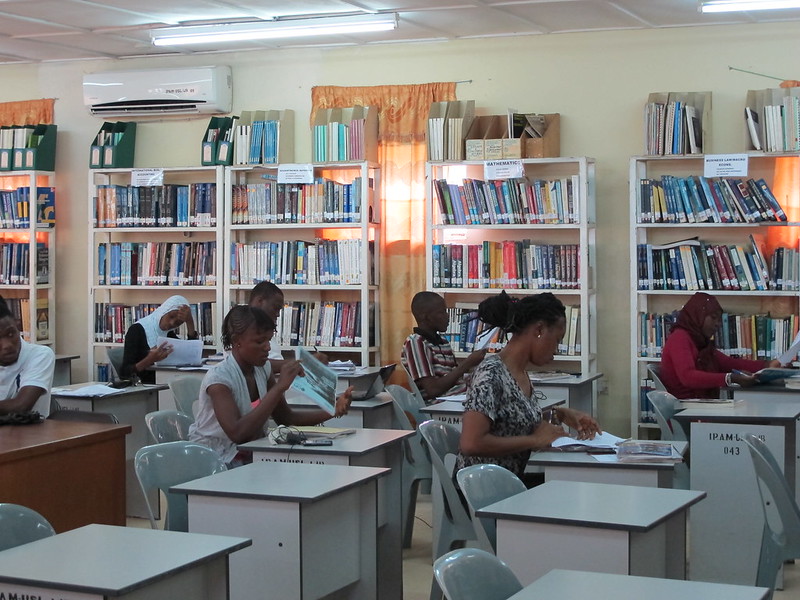 Sierra Leone is a low-income country on the West African coast that is still recovering from a decade-long civil war (1991-2002). The Ebola epidemic (2014-2016) only hindered Sierra Leone’s ability to bounce back, with children losing a year of schooling during this time. In 2019, 72.4% of Sierra Leone’s rural population lived below the poverty line and the adult literacy rate was 51%.
Gender Disparities in Sierra Leone’s Education Enrollment
Gender disparities exist in Sierra Leone’s education enrollment. For instance, in 2021, boys completed lower secondary education at a rate of 46%, while girls did so at a rate of 67%. Additionally, the United Nations Children’s Fund (UNICEF) reported that 27% of boys and 18% of girls completed upper secondary school.
A research paper published by IGI Global highlights the consistently low overall enrollment ratio in tertiary (higher) education in Sierra Leone from 1950 to 2010. It also reveals that from 1995 to 2010, the gender gap in higher education enrollment has widened.
Sierra Leonean students can only attend technical and vocational institutions or the University of Sierra Leone’s constituent colleges after finishing secondary school. As of 2020, 17 universities were registered with the Tertiary Education Commission (TEC) of Sierra Leone, along with 15 post-secondary institutions offering undergraduate degree programs through affiliation.
While the government has mainly focused on improving primary and secondary school attendance, the Ministry of Technical and Higher Education (MTHE) has also been focused on improving the quality of higher education in Sierra Leone.
Government Support for Higher Education
The Universities Act of 2005 reoriented higher education in Sierra Leone by supporting the establishment of private universities. There are at least 11 private higher education institutions in Sierra Leone that the TEC accredits. Many of these private institutions are affiliated with public institutions so that they can offer undergraduate degrees.
The MTHE offers students access to higher education through the government’s Grant-in-Aid and the Student Loan Scheme. Further, an Act of Parliament in 2001 instituted the Eastern Polytechnic and Milton Margai College of Education and Technology (MMCET) as polytechnics, ensuring that both institutions will focus on providing hands-on, applied education.
In 2023, the Minister of the MTHE, Dr. Ramatulai Wurie, outlined recent improvements in Sierra Leone’s higher education system and plans for further enhancements to the United Nations Educational, Scientific and Cultural Organization’s (UNESCO) Secretary-General. One notable improvement is the investment of 21% of the national budget in the Free Quality Education (FQE) program from 2018 to 2023.
Wurie emphasized President Julius Maada Bio’s objective to increase education funding. Wurie also stated that the government overall and the MTHE are improving “teaching methods, curriculum review… and youth empowerment.” UNESCO has also helped by providing support for the development of a National Science, Technology and Innovation Policy for Sierra Leone in 2022. Viewing middle manpower as crucial for Sierra Leone’s growth, Wurie emphasized the government’s commitment to strengthening the nation’s Technical Vocational Education Training (TVET) sector. This investment is aimed at boosting socioeconomic development and preparing the younger generation for the job market.
Higher Education Challenges and Solutions
Higher education institutions still need to update their academic programs to meet the current job market’s demands and the Assuring Quality Higher Education in Sierra Leone(AQHEd-SL) project is the first step toward doing so. In 2022, the AQHEd-SL pilot successfully helped develop curriculum review processes for eight post-secondary institutions in programs associated with health, science, technology, engineering and mathematics (STEM), management and agriculture. It also trained 37 quality assurance officers to work in universities and 450 university staff members in learner-centered teaching and critical thinking. The University of Sierra Leone led the AQHEd-SL partnership with many local partners, including Njala University and the University of Illinois Urbana-Champaign, U.S.
Establishing standard learning outcomes for programs in similar fields of study is another issue in Sierra Leone’s higher education system that needs to be addressed. Systems like credit transfer and standardizing qualifications across different institutions’ programs give students the flexibility to switch between different institutions across the country. The drafted National Qualifications Framework(NQF) is credits-based. It seeks to provide a form of standardization for learning programs in similar fields throughout different institutions within the country. According to the African Continental Qualifications Framework, Sierra Leone drafted a new NQF in 2024 and the document is being examined in a nationwide consultation process with stakeholders.
Higher education institutions have also complained for many years about political interference and requested more autonomy. Bio responded by using the Universities Act of 2021 to remove the role of Chancellor from all public universities. This legislation allows other citizens to be appointed in such a leadership position for public universities. There are also plans to address compliance concerns raised by the new leaders of the public universities by improving regulatory frameworks and providing more support for the new Chancellors.
– Elisabeth Nwasokwa
Elisabeth is based in Bellerose, NY, USA and focuses on Good News for The Borgen Project.
Photo: Flickr
