Everything You Need to Know About Poverty in Yemen
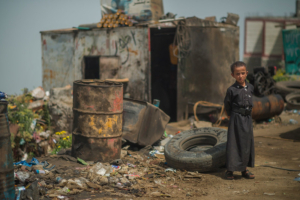 The Republic of Yemen occupies the southern end of the Middle East’s Arabian Peninsula. Bordering the Red Sea and the Gulf of Aden, Yemen was once the crossroads between Africa, Asia and the Middle East. From 1918 to 1990, Yemen was separated into two competing countries including independent North Yemen and British-backed South Yemen. In 1990, both countries unified to create The Republic of Yemen. However, despite these advances in government, the Yemeni political climate radically destabilized in 2011, as the Arab Spring swept across neighboring countries. Since 2014, a brutal civil war has gripped Yemen, leaving its population of 33 million vulnerable to disease, food shortage and overwhelming poverty. Today, Yemen is the second-poorest nation in the Middle East, and more than 80% of Yemenis live below the poverty line.
Here is everything you need to know about poverty in Yemen.
1. The Yemeni Civil War has destabilized the government
The Yemeni Civil War is a conflict primarily between Yemen’s internationally recognized government and the Houthi rebel movement, which claims its stronghold in Yemen’s northern territories. In 2011, uprisings forced Yemen’s authoritarian president, Ali Abdullah Saleh, to cede power to his deputy, Abdrabbuh Mansur Hadi. However, Hadi struggled to address the country’s corruption, food insecurity and militant incursions. In 2014, the Houthi rebel movement, allied with former president Saleh, seized control of Sana’a, Yemen’s capital and most populous city. The Houthis are an Iranian-backed Shiite group that has long undermined Yemen’s predominantly Sunni government. In 2015, Saudi Arabia and 8 other Sunni states with the help of U.S., U.K. and French aid, launched air attacks, hoping to restore president Hadi to power. The ensuing civil war has prompted a large-scale humanitarian crisis and has claimed the lives of over 15,000 civilians. Those remaining have been challenged with famine, poverty and disease outbreak.
2. The Yemeni economy continues to fail
Even before the outbreak of its civil war, Yemen struggled to keep pace with changing markets. Political corruption hampered Yemen’s economy, while revenues from oil and gas reserves continued to decline. The civil war has further damaged economic infrastructure, contributing to high unemployment and poverty rates, while also alienating international investment. Since the conflict’s onset, the Yemeni economy has shrunk by half.
3. Many Yemenis have been displaced by conflict
Civilian vulnerability to military attack has forced an estimated 4.5 million people or 14% of Yemen’s population to flee their homes. Many Yemenis have been displaced multiple times since 2015, ranking Yemen in the top six of internal displacement crises worldwide. As Yemenis continue to live in exile, they strain already limited food, water and sanitation resources.
4. Yemen nears famine
As a food-deficient country, Yemen has often relied upon imports to nourish its population. However, its civil war has stymied international trade and weakened its access to food supplies. Food prices have soared, hindering accessibility for Yemen’s poverty-stricken population. As a result, hunger is rampant, with many Yemenis forced to skip meals or to severely restrict portion size. Some have pawned belongings and sold assets to raise money for adequate food supplies. Oftentimes, Yemeni women struggle the most, giving portions to children and family members at the expense of their own nourishment.
5. Poverty in Yemen affects women and girls disproportionately
Women and children make up 80% of Yemen’s displaced population, with women heading 26% of displaced households. In the midst of such upheaval, women and girls are especially vulnerable to gender-based violence, often falling victim to child marriage and human trafficking. Widespread food insecurity and an eroding health care system have led to a severe increase in the maternal mortality rate: one woman dies in childbirth every two hours.
6. Communities are vulnerable to infectious diseases
Both the civil war and COVID-19 have strained Yemen’s already fragile healthcare system. 46% of healthcare facilities across the country are only partially functioning or completely defunct, due to insufficient staff, funding and medical resources. Similarly, large-scale displacement and infrastructure collapse has hampered access to clean water and sanitation facilities, with 9.4 million people in acute need of water, sanitation and hygiene services. As a result, communicable diseases have run rampant, including measles, diphtheria and polio. Yemen is also reporting an unprecedented cholera outbreak. From 2012 to 2021, Yemen reported an estimated 2.5 million cholera cases, with 4,000 cholera-related deaths.
7. Humanitarian aid combats poverty in Yemen
The crisis in Yemen has caught the attention of the international humanitarian community. With 21.6 million Yemenis in need of aid, the UN has designated Yemen the worst humanitarian crisis in the world. Despite Houthi attempts to block aid packages, several leading organizations have joined the effort to improve food access, water availability and medical services. For instance, UNICEF is supplying therapeutic food to treat acute malnutrition in children. Similarly, the United Nations Population Fund hopes to allocate $7 million to improve women’s access to reproductive and neonatal care, reaching an estimated 3.9 million people.
A Look Ahead
Though the civil war in Yemen continues to deny the Yemeni population economic security, adequate food supplies and basic health services, there is some chance of peace. In 2022, the UN brokered a ceasefire between Houthi rebels and the Yemeni government, which was renewed to extend from April to October 2022. Though the truce has technically expired, a mutual diplomacy has slowed the conflict, allowing back-channel discussions between Saudi and Houthi representatives to continue, albeit slowly. As the negotiations unfold, civilians hope for an escape from hunger, violence and poverty in Yemen.
– Sydney Verdi
Photo: Flickr
