Cable Cars Reduce Poverty in Bolivia
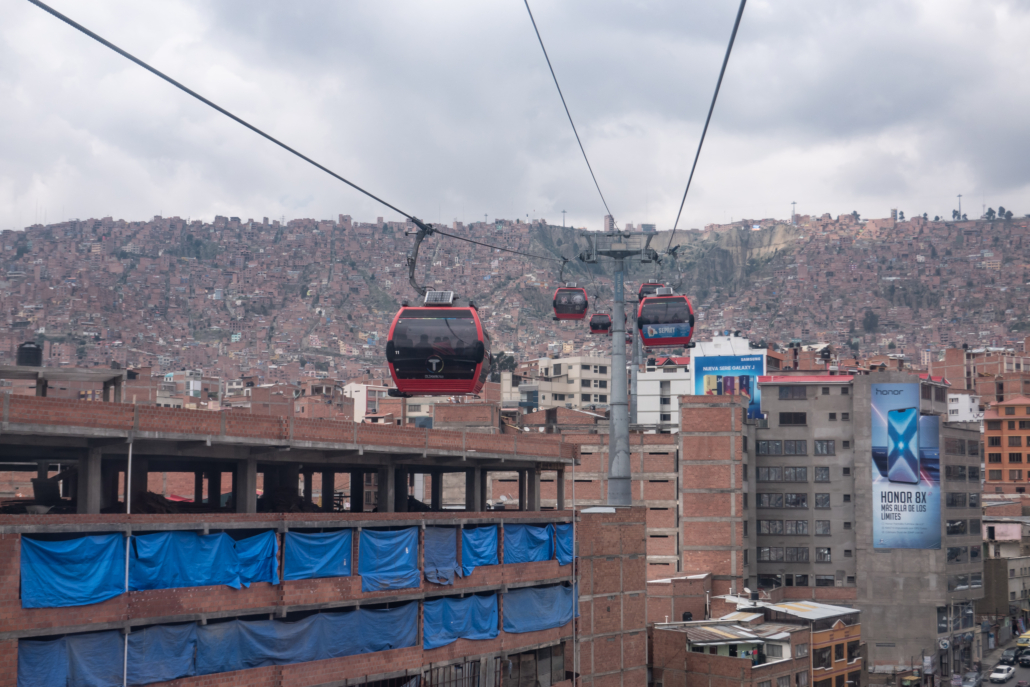
An above-ground public transportation system has recently taken hold in several Latin American countries, including Bolivia. In addition to aiding the environment, cable cars reduce poverty in several ways, and governments are targeting transport poverty and general poverty with these transportation infrastructure projects.
What is Transport Poverty?
Transport poverty is a culmination of several factors. Lucas et al. broke down these factors in a 2016 research paper. First is transport affordability, as those in transport poverty are often unable to pay for transportation. Mobility poverty is a lack of transportation, usually motorized transportation in the modern world.
Lucas et al. has defined accessibility poverty as barriers to physically reaching places of important activity “at reasonable time, ease and cost.” Finally, “exposure to transport externalities” is explained as the result of being exposed to adverse consequences of transportation such as roadway casualties and illnesses resulting from pollution.
Cable cars reduce poverty related to transportation by providing an accessible, fast, inexpensive mode of transportation. A 2014 news release by the North American Congress on Latin America (NACLA) details some key statistics on the cable car system in La Paz, Bolivia.
The cable car’s low fare of three bolivianos ($0.43) per ride is affordable. Accessibility is achieved with the commute from La Paz to the city of El Alto taking less than 20 minutes as opposed to 60 minutes, the usual time of an on-ground commute.
Poverty in Bolivia
Before going into greater detail on how cable cars reduce poverty in Bolivia, an introduction to poverty in the country is necessary. Despite its being classified as middle-income, a 2018 report by the Government of Canada claims Bolivia is “the poorest country in South America.” Bolivia’s extreme poverty rate in 2017 was 17%, again one of the highest in the continent.
How Cable Cars Reduce Poverty and Why They Are in Demand
A 2021 World Bank blog entry lists several positive impacts of cable cars on underprivileged populations in cities. Cable cars reduce poverty by improving the conditions in cities while expanding access to jobs and other forms of personal development.
The aforementioned cable car system in the city of La Paz, Bolivia is called Mi Teleférico, or “My Cable Car.” A 2020 research study by the World Bank provides a socio-economic rationale for this project’s development: 29% of urban residents of Bolivia live in poverty, which an accessible transportation system would help reduce.
Urban poverty reduction was a major objective in the development of Mi Teleférico. The Center for Economic and Policy Research (CEPR) explains a goal that the World Bank set in a 2014 article: accessibility to transportation opens access to job opportunities — a lifeline for poorer populations of cities in Bolivia.
Again, the cost of a ride on Mi Teleférico is not high. According to the CEPR’s article, the cable car costs three bolivianos ($0.43) per ride and reduces spending on fuel.
Following Colombia’s Example
A decade before Mi Teleférico, Colombia created a cable car system in Medellín. The CEPR’s article shows that not only did this system create more jobs, but Medellín’s cable cars also reduced poverty by providing other resources to the city’s poor. For example, in the areas surrounding cable car stations, public libraries are more available to commuters.
In addition, entrepreneurial hotspots have sprung up around these stations. Alejandro Echeverría, former director of urban projects under Mayor Sergio Fajardo, explained this in the CEPR’s article: in these areas, “people can get a cheap loan if they want to start up a small café or shop.” In short, cable cars reduce poverty around their stations as well as on their lines.
In the long term, hopefully, Mi Teleférico will help elevate the poor of La Paz, Bolivia like cable cars reduced poverty for those of Medellín, Colombia. Low fares, elimination of fuel costs and opportunities for commercial development around cable car stations lay the groundwork for a sustainable mode of transportation.
– Noel Teter
Photo: Wikipedia Commons
