Improving Education in Indonesia Through Access to Libraries
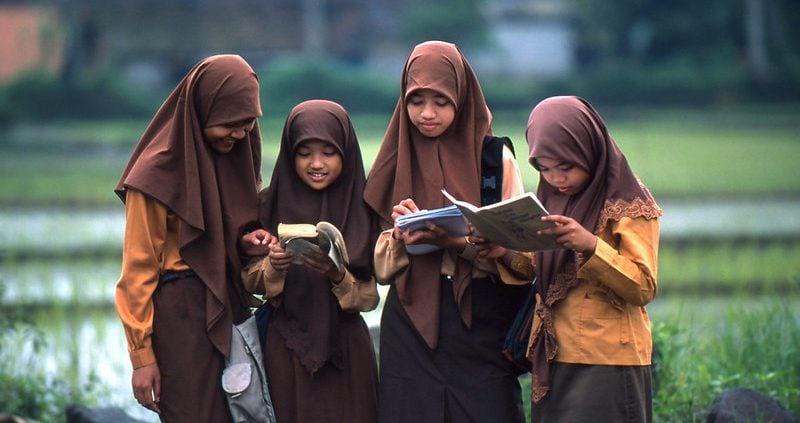 Education and poverty are inherently intertwined. According to the United Nations Educational, Scientific and Cultural Organization (UNESCO), if all students in low-income countries had just basic reading skills, almost 171 million people could escape extreme poverty. Poverty prevents access to proper education, and in turn, lack of education often leads to poverty. By improving education, individuals develop the skills, knowledge and tools to access higher-paying jobs. Education opens gateways of opportunity for the globally poor, allowing them to acquire more stable employment.
Additionally, education is useful for developing social, cognitive and emotional skills. But there is a major issue with access to education in various countries. According to the UNESCO Institute of Statistics (UIS), as of 2024, approximately 273 million children and youth across the globe do not attend school. Even those who do attend school may not be receiving an adequate education. Poorly trained, underpaid teachers, overcrowded classrooms and a lack of learning resources such as textbooks or pens and paper all contribute to this gap. In Indonesia specifically, literacy levels as a whole are significantly lower than the global average.
Education inequality is an extreme issue in Indonesia. More than 90% of schools are located in areas with limited or expensive internet connectivity. Schools in rural areas experience unequal access to education through limited accessible resources. Part of this inaccessibility is due to the costliness of online materials. Several groups in Indonesia recognize this shortcoming and the importance of proper education, and they are making efforts to improve accessibility to adequate education in Indonesia.
Digitalization and a Focus on Storytelling
Kipin is an Indonesian EdTech program used by almost 70 million young students, dedicated to improving access to education through digitalization. Working together with the Indonesian government, Kipin identified a problem with past education initiatives: They focused too much on “drilling” information and not enough on critical thinking. They recognized the burnout this method of learning caused and redirected education in a way that presents learning as a useful skill instead of a burden. Kipin aims to achieve this through digitalization, prioritizing quality and engagement. Kipin follows the National Curriculum and has produced more than 100 exclusive numeracy literacy books for students in grades one through six. Digitalization is helpful in aiding both parents and teachers to provide students with high-quality resources.
This new medium is effective because it relies on an illustrated storybook method. This method uses engaging visuals and daily scenarios to make information more digestible to students. This allows children to engage in learning voluntarily and without the fear factor commonly associated with subjects like math. It both keeps students engaged and helps them understand why what they are learning is important and applicable as a skill. Kipin’s technology also includes interactivity through the ability to annotate, encouraging development of motor skills.
This technology is available even to students in remote areas through systems such as Kipin MAX, Kipin Classroom and Kipin Perpus Desa. These systems allow students to download from a digital library of more than 60,000 curriculum-aligned materials in one visit to the village hall, for free, without needing an internet connection to access later. Along with national curriculum and literacy books, these programs also provide vocational books for workforce programs and local village information to foster community within Indonesia. This reduces education inequality, allowing students in areas most plagued by poverty to receive an equal chance at education on par with students in big cities.
“Human Libraries”
The National Library of Indonesia announced plans in 2025 to launch what it called “human libraries,” aimed at emphasizing human roles in a world increasingly shaped by artificial intelligence. This initiative was meant to keep libraries “relevant” and encourage learning outside of artificial intelligence (AI). Although AI is still a new technology, many reports show it can undermine a child’s foundational development. “Human libraries” were intended to allow individuals to seek knowledge outside of AI and interact with their communities on an intellectual level.
The National Library of Indonesia (NLI) initially planned to add 563 libraries in correctional facilities and 500 in local health centers by the end of 2025. However, the program has since been scaled back due to nationwide budget cuts. The institution distributed roughly 1,000 books total to community service locations, including correctional facilities, between 2024 and 2025. Officials said in early 2026 that the book-distribution program could not continue that year due to funding shortfalls. The NLI has said it is now working to expand collaborations with ministries, communities and international partners to sustain its literacy efforts despite the reduced budget.
Mobile Libraries and Libraries in Rural Areas
After a 2010 study done by the National Library showing how reading habits were limited, the Foundation for Mother and Child Health Indonesia, known locally as Yayasan Balita Sehat, began using mobile libraries to bring books to children, improving access to education for students in rural areas. Their solution operates with a smart car that brings books to Bojonggede, on the outskirts of Greater Jakarta, and a motorbike mobile library that delivers books to remote areas in West Timor. Additionally, the foundation operates two libraries in South Jakarta and Central Java in mother and child centers.
Similarly, the National Library of Indonesia has worked since 2007 to bring more comprehensive materials to libraries in rural communities. As of a 2014 report, the NLI had partnered with 450 district libraries to develop their collections, hardware and software, along with 160 libraries in small island and border regions and 50 libraries in coastal areas. It had also distributed 503 mobile libraries — including eight floating libraries serving seven provinces — to 33 provincial and 347 district libraries. More recent NLI data show the program has continued to expand. By 2018, the institution operated 584 mobile library vans and 80 motorcycle units. By 2024, its Social Inclusive Library Programme had partnered with more than 2,000 public libraries nationwide.
Through mobile libraries, groups in Indonesia are recognizing the education inequality caused by accessibility and affordability, and they are working to eradicate these barriers so that children on rural islands may have equal access to education.
– Arden Schultz
Arden is based in Milford, MI, USA and focuses on Good News and Politics for The Borgen Project.
Photo: Flickr
