Plagues of Old: Locust Swarms Become a Global Concern
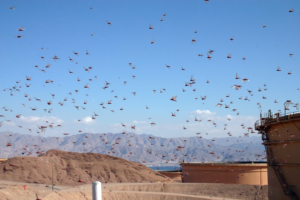 Plagues of locusts have devastated societies since the Pharaohs led ancient Egypt. From 2019 through 2020, Eastern Africa experienced its worst desert locust invasion in more than 40 years. In 2019, hundreds of millions of desert locusts began swarming in the Horn of Africa, the Middle East and South Asia, ravaging large areas of pastures and crops. By spring 2019, swarms spread north to Iran, Pakistan and India and south to East Africa, particularly the Horn of Africa (e.g., Ethiopia, Kenya and Somalia). The Desert Locust Control Organization for Eastern Africa (DLCO-EA), has taken preventative steps to offset desert locust swarms.
A swarm can consume the same amount of food in one day as 35,000 people. This directly threatens food security and induces a ripple effect, causing a profound loss of livelihood income and adversely affecting human capital. The repercussions are stark, with three million households compelled to forgo essential food, nutrition and education investments. The brunt of the impact is most acutely felt by households dependent on livestock and cropping.
Desert Locusts
Desert locusts usually form swarms under heavy rains, creating a mass of hungry insects that can cross continents and seas for food. The adults are pink (immature) and yellow (mature). They grow three inches in length. Their three to five-month life cycle has three stages: egg, hopper (nymph) and adult. Female locusts lay their eggs in warm, wet, sandy-clay soils at a depth of four to six inches. After hatching, the locusts mature and develop wings in two to four months. At this stage, they become difficult to eradicate. Since gregarious locusts can change their ecological and food habits, they can settle and breed in various habitats.
Locust Swarms Become a Global Concern
The National Aeronautics and Space Administration (NASA)-funded researchers worked to more accurately forecast when and where the swarms would appear. The team showed that examining soil moisture and composition could aid in predicting optimal breeding sites 85% of the time. In addition, researchers found the most effective time to eradicate desert locusts would be when the insects are in egg and hopper phases before wings develop.
In addition, scientists at Arizona State University created the Global Locust Initiative to “get people the information they need before a plague occurs,” stated Arianne Cease, director of the initiative. Cease became aware of the devastation locusts bring while in the Peace Corps in West Africa. Lastly, the Desert Locust Control Committee (DLCC) is the primary forum that supports locust-affected countries and agencies under the Food and Agricultural Organization (FAO) umbrella. The DLCC was established (1955) during a 12-year-long Desert locust plague in Madagascar.
Accordingly, the Desert Locust Control Organization for Eastern Africa (DLCO-EA), a regional pest and vector management organization, has taken several preventative steps to offset the onslaught of desert locust swarms. These include enhancing surveillance and control operations to facilitate early warning, optimizing control strategies and insecticides based on the situation and the environment, establishing and strengthening a Locust Control Unit (LCU) within the Plant Protection Services Division (PPSD) and more.
– Pamela Fenton
Photo: Flickr
